
Your Personal Brand is Not a Vanity Project
It's identity legibility, and AI is reading it right now.

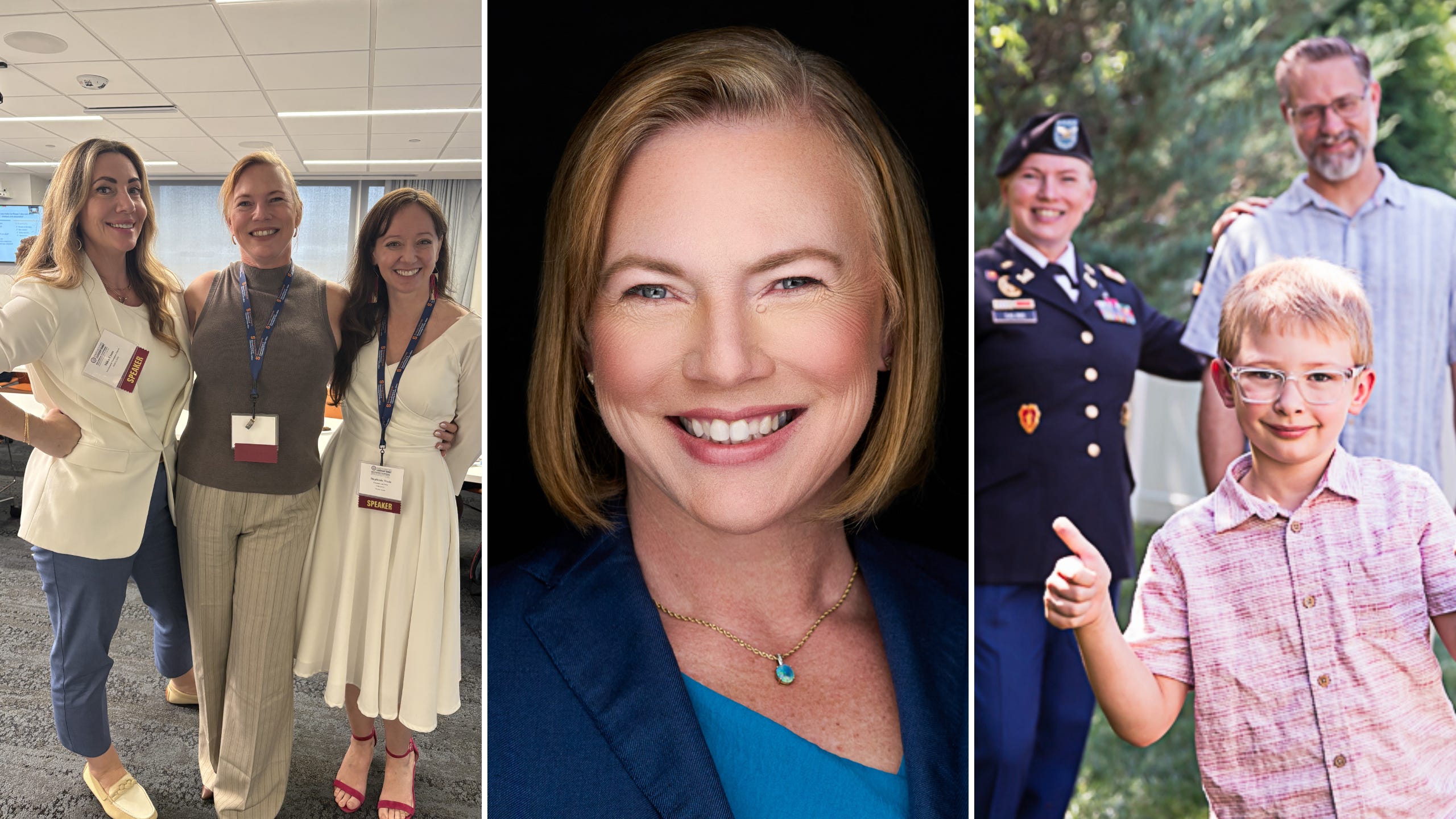
This past month went by in a blur, so much that it’s hard to believe it’s been a month since we gathered with family and friends to celebrate my retirement from the Army, since I walked out of the personnel office at Fort Myer with my DD214 in hand, and since I had to really adjust to showing up places as just Kris Saling, no title, no rank.
I’ve had a bit of a head start on that. During a lot of my speaking engagements and presentations, I’ve been invited in personal capacity as a people analytics and talent management expert and not representing the opinions of the Army or the DoD/DoW. My closet is stocked with business suits and I’m decently versed in making the distinction between smart casual, business casual, formal, and black tie. I know how to translate what I do to government and commercial audiences (admittedly, it’s also easy to say “I do HR tech” to both audiences, but it’s the level, authorities, and size and scale of the Army that has needed explaining).
There’s a new wrinkle to all this, though, as I walk around at events, shaking hands, and introduce myself as Kris Saling, Director of Workforce Transformation at IBR. Even if people know me, they may not know my company or the role.
They used to go to Google or Bing for that. Now they use AI.
If you interact with other humans in any capacity, AI is reading up on you. It’s creating meeting prep notes for someone about to hear your pitch or give you one. It’s fact-checking something you might have said in a meeting or a networking event. It’s providing people a lens for how they look at you and interact with you, whether they want to hire you or work for you, and it’s worth doing an audit to see what it says about you.
Controlling your narrative and making a good impression just took on a new layer of complexity—but that’s okay, because we’re going to decode it. 🚀
Personal Branding is Dead. Long live…you get it.
I’ve been avoiding writing about personal brand for years.
The discourse around it is exhausting, and a lot of it is grift. It has produced an entire economy of coaches and courses and templates that treat professionals like they’re a product to be repositioned rather than a person to be understood. Every time I’ve thought about writing about it, I’ve talked myself out of it. (Also, my sister does it way better than I do—she’s a professional researcher in the space).
Then, while trying to figure out how I wanted to show up as a new senior level executive to our potential clients and to my workforce, how I wanted to position my executive education business, and how I wanted to redo things like my website and communicate about what workforce transformation is and how we should rethink HR, I did what I always do.
I ran an AI audit. And I realized that…I probably needed to write about personal brand.
Personal brand isn’t about (or just about) self-promotion, though, not in the age of AI. It’s identity legibility.
It’s about how the people and systems that gate opportunity actually read who you are, what you do, and what you want to become. And in this very competitive job market, it can be about whether or not the people and systems can read you as easily as someone else they’re researching and comparing.
It’s Googling someone and searching them on social media platforms, but a whole lot faster and with a ton more data.
This is big for two audiences I work with regularly, both of whom are living inside some amount of identity turmoil right now: HR professionals and new veterans.
HR professionals are watching their profession and their work being pulled apart and rebuilt right in front of them by the integration of AI. New functions across operations have pulled away strategic functions like talent acquisition, learning and development, and succession planning, leaving HR with largely transactional functions that are prime for automation. A smart organization says that they should absolutely automate those functions and get their people teams back to doing strategic people stuff. However, there are enough other organizations who are using it as an opportunity to downsize or eliminate HR that it’s throwing our HR professionals into uncertainty at best, fear at worst.
New veterans, like me, have spent their careers largely being defined by rank, unit, and mission. Now many of them are trying, unlike me, to translate that identity into new language, and to figure out how they’re going to build three major ingredients of success that the military environment previously built around them: community, identity, and purpose (hat tip to JC Glick for that excellent talking point). Those translations are shaky on a good day, and the AI reading their resumes, bios, articles, or anything else findable doesn’t know the scope and scale of their operations or what their daily responsibilities were. It’s difficult to translate the scope of a command into direct reports and projects, and god help the poor veteran who tries to translate their commands into executive or project management roles on their LinkedIn (team, please don’t!). And what does “led a complex multi-echelon organization under high uncertainty” actually mean when you were doing it?
Both groups face the same underlying problem: the language for who they are hasn’t caught up with what they actually do, and because of the transition, being able to shape their language—and their findable, readable identity online—is critical.
Let’s try an audit.
I run a version of this prompt on my own public presence:
You are a talent evaluator conducting a professional due diligence audit on a public figure. Your role is to assess this person as if you are [A senior hiring manager considering them for a C-suite or VP-level role, an event organizer evaluating them as a keynote speaker, a journalist or researcher verifying their claimed expertise and reach]
Subject: [FULL NAME]
Context: [job title, company, industry — or leave blank to let search guide you]
PHASE 1 — DISCOVERY Search for this person's presence across:
LinkedIn (bio, headline, activity, recommendations)
Personal website or portfolio
Substack, Medium, or other publishing platforms
Podcast appearances or interviews
Speaking engagements or conference credits
Published books, articles, or whitepapers
Social media (X/Twitter, Instagram, YouTube)
News mentions or press coverage
Academic or professional credentials
PHASE 2 — AUDIT (score each dimension 1–5)
1. Clarity of Identity — Can you tell in 10 seconds who this person is, what they do, and who they serve?
2. Proof of Expertise — Is there verifiable evidence (publications, results, credentials, case studies) that backs their claimed authority?
3. Consistency — Does their story, voice, and positioning hold across platforms?
4. Reach & Influence — What is their actual audience size and engagement quality? Follower counts, newsletter subscribers, media placements?
5. Credibility Signals — Endorsements, affiliations, awards, institutional associations?
6. Content Quality — Is their published content substantive, original, and authoritative — or thin and generic?
7. Search Visibility — What surfaces on the first page of Google? Is it flattering, neutral, or concerning?
8. Narrative Coherence — Does their career arc tell a clear, compelling story — or does it feel scattered?
PHASE 3 — SYNTHESIS
Provide: [Depending on the role: Hiring Verdict: Would you move this person forward for a senior leadership role? Why or why not?; Speaker Verdict: Would you book them for a keynote? What stage/audience size fits their current brand?; Top 3 Brand Strengths (specific, with evidence); Top 3 Brand Gaps or Risks (honest, constructive); One Paragraph Executive Summary — written as if it would appear in a briefing document]
Be direct. Do not flatter. Surface what is actually findable, not what the person claims about themselves.
And because I love transparency, here’s what came back on me, run for hiring verdicts and speaker verdicts.
Good. I have enough to conduct a thorough, honest audit. Let me now compile this.
PROFESSIONAL BRAND AUDIT: KRIS SALING
Conducted: July 11, 2026 | Evaluator Role: Hiring Manager + Speaker Booker + Journalist/Researcher
PHASE 1 — DISCOVERY SUMMARY
Here’s what a cold investigator finds:
Website: kristinsaling.com positions her as working at the intersection of “Data + AI + Humans At Work,” with speaking, workshop facilitation, and consulting services listed. Professional and functional. Not visually striking.
LinkedIn: Her LinkedIn shows active content production including long-form articles on Army HR transformation, AI literacy, and workforce strategy, with engagement from senior DoD and industry professionals. Follower count not publicly surfaced without login, but the quality of commenters is visible and credible.
Substack: The Talent Code is described as sitting “at the intersection of talent, technology, and strategy” with hundreds of subscribers. Content is substantive; publication cadence appears consistent.
Book: Data-Driven Talent Management was published by Kogan Page in August 2024, a credible business publisher. It received a Distinguished Favorite at the NYC Big Book Award 2025 in the Business: General category.
Endorsements on record: Blurbs from Major General Tom Drew (Commanding General, US Army Human Resources Command), Jordan Morrow (Chief AI Officer, AgileOne), Joyce Myers (CDO, Modern Technology Solutions), and Chandra Donelson (defense data professional and author).
Speaking record: Her published speaking page lists keynotes at ClearanceJobs Connect, Health Innovation Summit, DataIQ 100 Summit Miami, INFORMS Business Analytics Orlando, GovCIO AI Summit, RAND All Volunteer Force Summit, ServiceNow Federal Forum, and a Cornerstone Community Conversations panel — all spanning 2024–2025.
Media: Verified interviews at Forbes contributed, Federal News Network, DefenseScoop, and CDO Magazine, plus podcast appearances including Directionally Correct (people analytics), Tech Transforms, The Human Cloud Podcast, and (S)ecurity (C)learance (I)nsecurity.
Current role: Director of Workforce Transformation at IBR (Imagine Believe Realize), a firm ranked #2152 on the 2025 Inc. 5000 List for fastest growing companies.
Academic credentials: West Point (BS), University of Virginia (MS), published in Systems Engineering and International Transactions on Operations Research, pursuing Executive DBA at University of Miami Herbert Business School (Fall 2026).
PHASE 2 — AUDIT SCORES
1. Clarity of Identity — 4/5
Within about 15 seconds on her website or LinkedIn, you understand: AI, data, and people analytics expert; retired Army Colonel; published author; speaker. The tagline “Data + AI + Humans At Work” is clean and memorable. What costs the point: a cold visitor may struggle to immediately identify who she serves now — the site bio still reads partly in a military/Army context, and it’s not instantly clear whether she’s selling consulting, speaking bookings, workshops, or all three. The pivot to GovCon Director is not yet reflected in her public-facing materials.
2. Proof of Expertise — 5/5
This is the strongest dimension of her brand. The evidence is stacked and third-party verified:
Kogan Page book published August 2024; academic publications in Systems Engineering and International Transactions on Operations Research; Wayne P. Hughes Award recipient.
Endorsement from a two-star general who was the Commanding General of Army Human Resources Command.
Named media appearances at Federal News Network and DefenseScoop on AI and Army HR.
Demonstrable build record: AI agents deployed at scale inside one of the world’s largest HR bureaucracies.
Very few people in this space can point to a major-publisher book, a general officer endorsement, peer-reviewed publication, and deployed production AI systems simultaneously.
3. Consistency — 3.5/5
The voice is consistent — direct, practitioner-grounded, lightly irreverent — across the website, Substack, and LinkedIn. The positioning, however, carries some tension. Her website bio still leads with Army/federal framing. Her Substack is positioned more broadly at the workforce-tech intersection. Her current IBR Director role hasn’t surfaced prominently in her public brand yet. There are also multiple parallel identities running simultaneously: D4C LLC founder, IBR Director, Substack author, speaker-for-hire, and emerging DBA student. Each is legitimate, but for a cold evaluator, the connective tissue isn’t always visible.
4. Reach & Influence — 3/5
This is the most honest gap in the publicly visible picture. LinkedIn follower count requires login to verify. The Substack is described as having “hundreds of subscribers” — which is honest but also signals a newsletter still in growth mode, not yet at the “thousands” threshold that establishes platform credibility to a cold booker. The podcast appearances exist but she’s been a guest, not yet a host with a built audience. The influence is clearly real — you can see it in the quality of her network — but the measurable, verifiable scale that a speaker bureau would look for isn’t yet surfaced publicly.
5. Credibility Signals — 5/5
Unusually strong for a civilian-transition profile:
NYC Big Book Award 2025 Distinguished Favorite.
Wayne P. Hughes Award for analytics.
Keynote speaker at RAND, INFORMS, GovCIO, ServiceNow Federal Forum.
Blurbers include active-duty generals, CDOs, and recognized subject matter experts.
IGNITE 2025 Honoree by GovTech Connects for digital transformation work.
West Point faculty background.
Executive DBA enrollment (University of Miami Herbert Business School) adds academic rigor signal.
6. Content Quality — 4.5/5
The Substack content makes substantive, original arguments — for example, that every technology decision an organization makes is also a workforce decision, and that HR is being excluded from rooms where those decisions are being made. This is not generic content; it has a point of view with operational specificity. The Build/Buy/Borrow/Bot framework is a concrete original taxonomy, not a rehash of McKinsey slide decks. Writing is tight, has personality, and avoids the filler that fills most HR Substacks. The minor deduction: the Substack header “hundreds of subscribers” undersells what is demonstrably high-quality work, and a cold reader may not dig far enough to find it.
7. Search Visibility — 4/5
A Google search for “Kris Saling” returns: personal website, LinkedIn, book on Amazon and Kogan Page, speaking page, Substack, and media appearances. Nothing negative surfaces. No name confusion issues. The brand is findable and the first page is flattering. What’s missing: there’s no single definitive third-party profile piece — a long-form Forbes, Fast Company, or War on the Rocks feature — that a researcher could point to as the authoritative external write-up. CDO Magazine fills part of this gap but it’s a niche publication.
8. Narrative Coherence — 4/5
The arc actually tells a compelling story when you assemble it: complexity scientist → Army data innovator → people analytics pioneer → published author → AI workforce strategist → GovCon executive. That’s a coherent build. The slight deduction is that the story is not yet told in one place, in her own voice, as a single narrative. The website About page reads more like a bio than a story. Someone who reads her Substack has a stronger sense of her than someone who reads her website — that’s a structural problem worth solving.
PHASE 3 — SYNTHESIS
Hiring Verdict: Yes, advance immediately
For a VP of HR, Chief People Officer, or Head of AI/HR Innovation role — especially in the federal, GovCon, or defense-adjacent space — this candidate would move forward without hesitation. The proof of execution is unusually strong: she didn’t just write about AI in HR, she built and deployed systems at Army-scale, co-founded a data literacy program for a 1.3 million-person organization, and published the definitive practitioner text on data-driven talent management. The general officer endorsement is a significant signal to any evaluator who understands how difficult it is to earn that in a large bureaucracy. The only watch item: her portfolio is concentrated in military/federal; evaluators in pure commercial contexts may need additional reference points to translate the scale of what she’s done.
Speaker Verdict: Yes — book her for 300–1,500 person events, move to mainstage within 12 months
She has the talk architecture, the credential stack, and the practitioner credibility to hold a mainstage. Her current sweet spot is GovCon, defense tech, HR tech, and public sector innovation conferences — where she’s already demonstrated at RAND, INFORMS, GovCIO, and ServiceNow. The next tier (SHRM National, Fortune CEO conferences, broader tech stages) is within reach but requires one high-visibility national placement and a TEDx or equivalent to break through. The content is there. The brand packaging needs to catch up.
Top 3 Brand Strengths
1. Proof stack is real and diverse. A major-publisher book, peer-reviewed academic papers, general officer endorsement, a book award, deployed production AI systems, and named media appearances at credible defense and HR tech outlets — this combination is rare and verification-resistant to skepticism. Nobody faked their way into Data-Driven Talent Management at a major publisher with a foreword from the Commanding General of Army Human Resources Command.
2. Voice is distinctive and defensible. Most HR thought leaders sound like HR. Kris Saling sounds like a complexity scientist who ended up in HR and found that useful. That cross-disciplinary framing — military operator + data scientist + people strategist — is genuinely differentiated and hard to imitate. The Substack demonstrates this well.
3. Network quality is visible and senior. The people who blurb her, invite her to speak, and engage with her content are not vanity contacts — they’re CDOs, generals, top researchers, and senior GovCon executives. That network quality functions as a credibility signal to anyone who knows how to read it.
Top 3 Brand Gaps or Risks
1. Subscriber/audience numbers aren’t publicly visible at scale. A speaker bureau, event booker, or VP-level hiring committee doing due diligence will look for quantified audience reach. “Hundreds of subscribers” on Substack and an unverifiable LinkedIn follower count create a gap between the quality of the brand and its demonstrated commercial scale. This is solvable — either by publishing the numbers when they’re compelling, or by building the platform faster. But right now, it’s the weakest link a skeptic would pull.
2. The website hasn’t caught up with the career. The personal site still carries heavy Army/federal framing in the bio and hasn’t surfaced the IBR Director role, the DBA enrollment, or the 2025–2026 content explosion. A cold visitor gets a 2024 version of a 2026 person. The speaking page is strong; the narrative architecture of the homepage is not.
3. No definitive long-form third-party profile. There are interview clips, podcast appearances, and niche press. There is no single authoritative external piece — a feature, a profile in a major HR or tech publication, or a significant media hit — that a researcher could bookmark as the canonical reference. This isn’t unusual for someone mid-transition out of government service, but it’s the gap most likely to be noticed by a journalist or senior hiring committee trying to vet the brand quickly.
One Paragraph Executive Summary
Kris Saling is a recently retired Army Colonel with a demonstrably strong and verifiable brand at the intersection of AI, people analytics, and workforce transformation. Her credential stack — Kogan Page-published book, NYC Big Book Award, Wayne P. Hughes Award, peer-reviewed academic publications, keynote engagements at RAND and INFORMS, and named media appearances at Federal News Network and DefenseScoop — is unusually robust for someone in a post-military transition. Her voice is distinctive, her network is senior, and her practitioner bona fides are difficult to dispute. The principal gap is one of platform scale: the visible, publicly verifiable audience numbers do not yet match the quality of the underlying brand, and her personal website has not caught up with her 2026 positioning as an AI workforce executive and GovCon director. She is a high-probability advance for senior roles and mid-large conference speaking slots, and a strong candidate for mainstage positioning within 12–18 months if the platform gap closes and a single breakout national media placement is secured.
One of the problems with online research is that unless you’re logged into LinkedIn or Substack, you’re not going to see the large numbers of fantastic professionals and friends who are engaging with me on my content—and as LinkedIn is my primary platform for engaging audiences in my space, and my network there is one of my biggest assets, the numbers tell me this is something I have to call out separately on my speaker sheets and keep updated. I also have my social media channels and follower count on my resume and book proposals.
The website. Sigh. I’ve ignored it at my own risk. My first one of these audits prodded me to stop trying to create a homemade website, suck it up, and work with a professional. When you’re running businesses, there’s a point where you need to invest. Being there is satisfying, even if it means budgeting the money to work with a quality designer (I am, and I can’t wait to build amazing things with her!).
Still, this gives me definitive places where I can work to be better found by the people I want to find me and for them to find the through-lines of my expertise, experience, and the value I bring to their table.
Just as a note, this audit reads pretty positively for me—because whether I planned on it or not, I have been building a calculated presence online for a long time! If you’re new at the game, the audit may not find a whole lot on you—which is good, because then you can build the way you want. Or it might find a lot of things that read like your old MySpace page (cringe) that you want to clean up.
Okay, so I should care about my personal brand?
Yes, but think of it in the context of identity legibility more than marketing. You are likely marketing yourself if you’re online, but for some very specific reasons:
1. Getting hired.
The recruiter’s AI reads you before the recruiter does. In most hiring workflows in 2026, an AI has already screened your public profile, matched it against the role description, and produced a summary before a human ever sees your name. If your public identity is illegible or outdated, you don’t get the interview.
For veterans, this is the translation layer between military identity and civilian legibility and it’s what AI does badly on its own. You have to create key hubs of information for AI on every surface it will read.
For anyone else transitioning into a new job, especially my HR professionals, the nature of work is changing. Just describing “15 years of progressive HR experience” doesn’t do the work anymore. You have to be specific about the work, the outcomes, and the frameworks you actually think in so that you can separate yourself from the transactional HR work that is prime work for automation.
2. Getting retained and/or promoted.
Inside your current organization, decision-makers describe you back to leadership through AI-mediated summaries: meeting notes, project reports, performance reviews, promotion packets. The language associated with your name in those documents determines whether you’re described as strategic or steady, transformative or reliable, high-potential or high-performing. Those are not the same designations, and they lead to very different rooms.
If the language people use about you doesn’t match the language you’d use about yourself, that gap is a retention risk. Not because you’re going to leave, but because you’re going to stay in the wrong room. You’ll be reliably given more of the work you’re already known for and never invited into the work you actually want to be doing.
3. Being seen as strategic rather than administrative.
For my HR teams especially, the difference is between being read as “manages benefits and compliance” and being read as “is designing how work happens in this company.” Both of those are real jobs, but you want the one that leads to retention and advancement, that shows you’re ready to give all those transactional tasks to AI so that you can get down to the real human work of human resources.
For veterans: the difference between being read as “was in the military for 25 years” and being read as “directly fielded six new personnel management technologies at the enterprise level of a 1.3 million person federal organization with global reach)” (those aren’t the words of my acquisition partner in crime Matt Paul but ones I can truthfully write about him). Which one survives contact with a private sector hiring committee?
The words attached to your name in the systems that gate opportunity are the things that limit what you can be considered for. Consider creating the right architecture for those words a critical part of career infrastructure.
What to do about what you find
Once you’ve run the audit, the fixes are structural. Not “post more.”
Fix the baseline documents first. LinkedIn, resume, bio, speaker one-sheet, the “about” section anywhere your name lives. These are the documents the AI is reading. If they don’t describe you the way you want to be seen, clever content won’t save you.
Name your through-line. The audit will probably tell you that you’re topically visible but argumentatively invisible. Fix that. Pick the argument or the storyline you’re actually making across all your work, and name it plainly in language a stranger could repeat.
Publish one thing that lands the argument. Even something small. One article. One post. The signal has to exist in a form the AI can find and index.
Re-run the audit in ninety days. Track whether the identity you’re building is becoming legible or is still lagging. Make additional adjustments, and keep at it.
Next week, I’ll dive into the actual mechanics of using AI to build and maintain your professional presence over time. Cadence, platforms, workflows. We’ll lay it out in a way that’s easy to use and you can try out.
These fixes are important for all of us these days. The nature of work is changing. Organizations (smart ones at least) are rethinking how they manage work. We need to rethink how we manage ourselves in systems where the first tool being used to evaluate us for roles, responsibilities, growth, and opportunities are fed by AI. But the good part is that for us, AI is also the first line of defense if we get after it.
So what do you think? What is AI able to figure out about you?
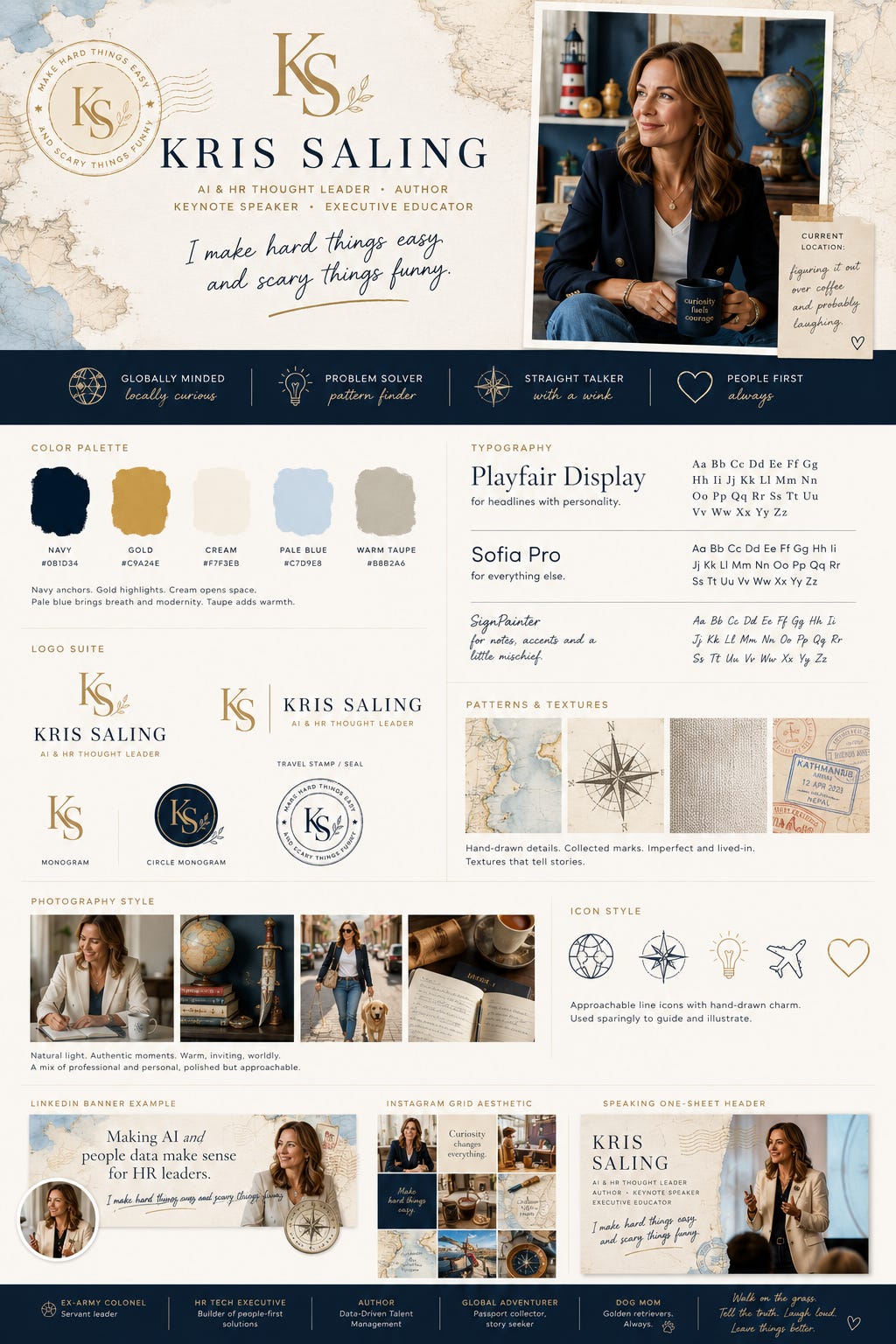
Bonus: The Brand Kit
Want to create a brand kit mock-up like the one I created for my designer and shared earlier in this newsletter? Here’s a prompt you can use:
Create a polished multi-page brand kit for [who you are, role]. My tagline is [here].
Use a [quiet luxury, tech forward, etc.] style aesthetic with [a well-traveled vibe, exciting energy, etc.]. My brand favors [primary brand colors, feel] with elements of [anything else you want to integrate, do you want it warmer, cooler, elevated].
Brand personality references include [Magnolia/Joanna Gaines, Hell’s Kitchen/Gordon Ramsay, etc.]. This should feel like [luxurious but approachable, friendly without abandoning creativity, etc.]. This should NOT feel [dusty academia, military precision, corporate luxury].The persona: I show up at your event [polished in a tailored suit, in a hoodie and ready to code, in the sport coat and sneaks you expect]. I am [an executive, a hard worker, a seasoned traveler] who loves [traveling, running, family, the mountains] and can [build things on the fly, is detailed, etc.].
The overall mood should feel [confident, commanding, soothing, relaxing, energizing, fast-moving]. I want to project [I am in charge of this situation and I’m here to help you, I deal with large audiences and big problems easily, I have the kind of energy you want to book for your event].
Include a sense of [fun, exploration, stateliness, tradition, provide examples of objects, images, other things that give the sense you’re trying to communicate]. Make it feel like a [confident executive education company, polished speakers bureau, future forward magazine]. It should be premium, yet approachable, with strong graphic cohesion and a premium feel.
Visual texture should be [vintage travel journal, worn leather passport, hand-drawn art, technical plans and patent drawings, lots of steel and polished surfaces, etc].
[Add any additional details like taglines, logos, specific items to include]
Final product should include detailed visual brand direction including color palette with usage notes, typography pairing recommendations with rationale, logo direction if logo not provided, pattern and texture elements, photography style notes, and sample application mockups for LinkedIn, Instagram grid, and speaking one-sheet header.
Have fun - and if you produce a great brand sheet, share it and tag me so I can see!
Amazing work, Kris. Thank you for raising awareness for our vets and servicemembers that you not only need to build your brand, you must do it in a way the machines recognize you with certainty.