The AI Talent Paradox
The same tools making your best people more productive are quietly eliminating the roles that develop the next generation of them. So how do we build new leaders?


AI adoption is making organizations faster, leaner, and more productive. And AI adoption, implemented without deliberate design, is quietly hollowing out the career pathways that develop the people those organizations will need in five years.
We’re calling this the AI talent paradox. These aren’t tradeoffs—you just have to see that both are true in order to make good future workforce decisions. But right now, most organizations are only seeing one of them—the efficiency. Some are noticing the elimination of entry level talent but are treating it as a cost savings.
As with so many talent decisions, if we don’t address this, then we sacrifice the strategic future for the tactical win.
Let’s decode it. 🚀
The Hidden Educational Value of the Entry-Level
What we’re losing beyond the transactional work they used to do

One of my biggest concerns as I look at the landscape of talent management and workforce planning right now is that when we talk about AI replacing work, we frame it as an efficiency conversation. The junior analyst used to spend twelve hours pulling data and formatting reports. Now AI does it in under two minutes. The junior writer used to draft first-pass communications. Now AI drafts them. The junior coder used to write boilerplate. Now AI generates it. Productivity up, cost down, great. Right?
Not so much.
The twelve hours those junior analysts, writers, and coders used to spend on those transactional tasks were not just for output. They were for education on the business domain and how information is shared and decisions made in that domain.
Entry-level roles have for a long time acted as a structured environment where professionals build three things for business acumen: pattern recognition, institutional knowledge, and judgment under real conditions.
Unfortunately, pattern recognition comes from doing the same kind of work repeatedly, in slightly different contexts, until you start to see the shape of problems before they’re fully articulated. The analyst who has pulled a thousand data sets develops an instinct for when a number looks wrong. The writer who has drafted a hundred communications develops a feel for when the message isn’t landing. The coder who has written a thousand lines of boilerplate starts to see architectural problems before they become crises. This is why your hiring manager looks for years of experience—the specific, neurological result of repeated deliberate practice in a domain. And exactly the thing that AI is best geared to take over.
Institutional knowledge is the embedded understanding of how a specific organization actually works, not how the org chart says it works, how decisions get mate, which relationships matter (Craig Starbuck gave an excellent talk at our Voices conference in Austin on using network diagrams to map your org instead of hierarchical org charts), what the real constraints are, and which closets have the skeletons in them. This knowledge transfers informally, through proximity, through watching senior people navigate complexity, through being in the room—or in the Pentagon, the line at Starbucks. Junior roles create the structural excuse for junior people to be in the right place to see business in action.
And judgment—the capacity to make good decisions with incomplete information, under time pressure, with consequences—develops specifically through being given low-stakes problems to solve and gradually increasing the stakes as competence grows. You cannot develop judgment by watching someone else exercise it. You develop it by exercising it yourself, failing safely, and absorbing what that teaches you.
When AI absorbs the early-career work, it absorbs the scaffolding for all three of these functions. The output gets produced, but the learning doesn’t.
The pipeline problem occurs because this learning is acknowledged but not intentional
The decision to defund the talent pipeline isn’t necessarily deliberate, either. No one is sitting in a boardroom saying, “Let’s eliminate the roles that develop our future leaders!” What’s happening is a little bit of a combination of short-sightedness and a failure to see the forest for the trees. A series of short-sighted individual productivity decisions aggregate into a strategic structural problem because they compound, and because we’re both counting on experience to develop the skills of future leaders but not actively investing in those roles, many people fail to see the problem.
Instead, we see the same sequence. An organization deploys AI tools and encourages adoption. Productivity increases. Headcount plans get revised. If three people can now do the work of five, you hire three next year instead of five. The work that used to require a team of junior people now flows through a smaller team of more senior people augmented by AI. Efficiency, by every measure that gets reported.
What doesn’t get measured is the cohort effect. The three people doing the work today are senior because they came up through a system that had five junior roles feeding the pipeline. The junior people who were supposed to develop into tomorrow’s seniors, the ones who would have taken those five roles, aren’t being hired. Or they’re being hired into positions that have been restructured to remove the developmental scaffolding. Or they’re being given AI tools that do the pattern-recognition work for them before they’ve built the capacity to do it themselves.
Three years from now, the organization looks at its talent bench and wonders why there are no strong internal candidates for the senior roles opening up. The pipeline dries up, not because someone decided to turn off the tap but because people weren’t paying attention to how talent flowed into their organization.
I’ve watched this pattern in the federal sector specifically. The federal workforce has an aging demographic profile that everyone in government talent management knows about and worries about. The knowledge transfer problem, how you get what career civil servants know into the heads of the people replacing them, is already a significant challenge. AI adoption that degrades the entry-level roles those replacements grow through makes an existing structural problem materially worse.
And because the federal sector has constraints on how it hires and develops talent that the private sector doesn’t, the recovery time is longer. You can’t just hire your way out of a pipeline problem in government the way you might in a startup. The consequences are slower to appear and harder to reverse.
The Eliminate → Simplify → Automate → Elevate Discipline, Applied to People
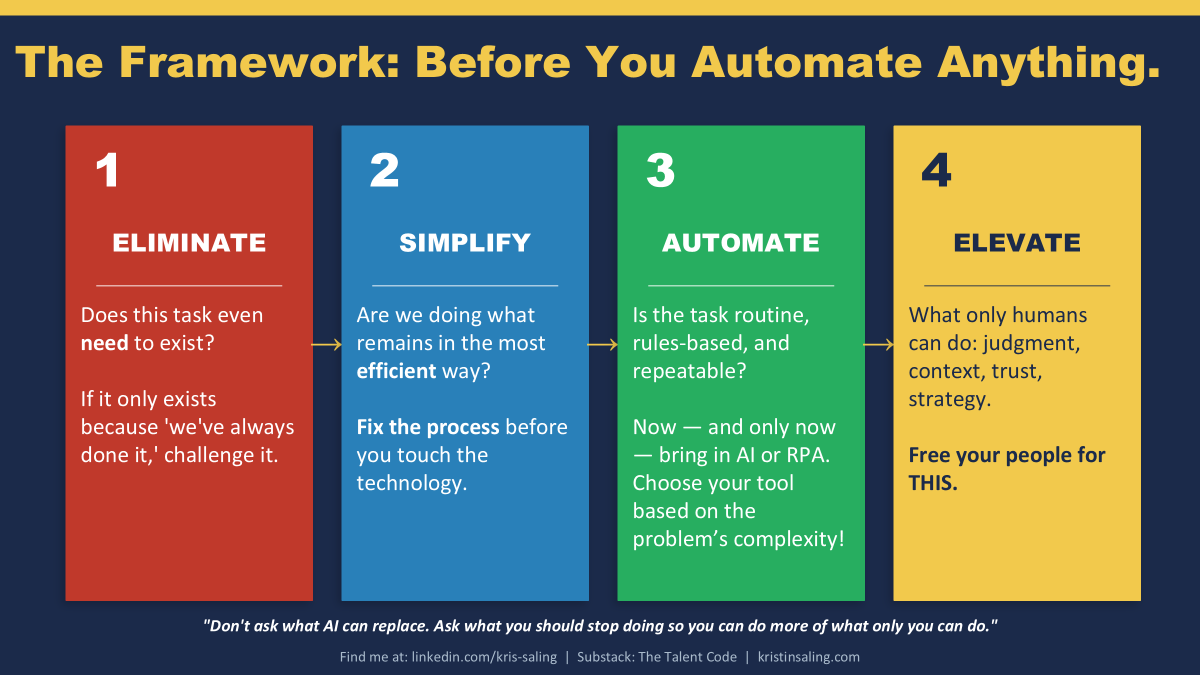
We’ve adopted this in my office as a method of reviewing business practices before deciding where to apply technology, but it works pretty well for deciding how you’re going to restructure a role, too. The idea is that before you automate anything, ask: does this process need to exist? Can it be simplified? Only then should you ask whether it should be automated.
The same discipline applies to decisions about roles.
Before you restructure a role because AI can now do parts of it, ask: what does this role do that isn’t captured in its output metrics? What does the person in this role learn by doing it? Who do they learn from, and what do they absorb through proximity that can’t be documented in a process guide? What would be lost, not in deliverables, but in development, if this role ceased to exist in its current form?
These are not questions that show up naturally in an efficiency analysis. They require someone in the room who is thinking about talent development as a strategic function rather than a cost center. And in most organizations, that person either isn’t in the room when AI adoption decisions get made or isn’t empowered to adjust a productivity win for a talent development reason that won’t show up on any dashboard for three years.
This is the governance gap at the center of the paradox. AI adoption decisions are being made by people optimizing for near-term productivity. Talent pipeline decisions are being made (or not being made) by people who may not fully understand the productivity changes happening around them. The two conversations are happening in different rooms, and almost nobody is connecting them.
Almost. The organizations that are going to have the advantage in this space are the ones who look at the work that’s being done and make total workforce decisions. They need a holistic look at how work is being done both by humans and agents, and how those are working in combination.
What responsible adoption actually looks like…
Let’s highlight one thing here: I am not arguing that organizations should slow down AI adoption to preserve entry-level jobs as they currently exist. That’s not responsible stewardship of your workforce any more than it would be responsible stewardship of your infrastructure to avoid upgrading it because the old system employed more people (both are decisions I’ve seen made).
What I’m arguing is that the decision to deploy AI in ways that affect early-career roles should be made with the same intentionality you’d bring to any major workforce design decision, which means accounting for the full cost, not just the efficiency gain.
Look at your total talent pipeline. What skills do you expect your mid-level to have, and where do they develop them? Where would you look for these, and, more importantly, whose responsibility is it to develop them? Yours? University education? Boot camps and workshops? How will you ensure you either hire or train the workforce you need at each level, and how are you assessing their talent?
The organizations that are getting this right are doing a few specific things.
They’re separating AI augmentation from AI replacement in their workforce planning. Augmentation changes how the work gets done, and replacement eliminates the role. These have different talent implications and should be tracked differently. When AI replaces the role entirely, that’s a pipeline decision that needs to be examined as such.
They’re redesigning roles rather than eliminating them. If AI now handles the data pull, what does the analyst role become? If AI drafts the first pass, what does the communications role develop into? The answer isn’t “a smaller team of more senior people” if you want to keep growing. The answer is a reconfigured role that still provides the learning arc and that uses AI to elevate the floor while preserving the human judgment development that matters. This requires deliberate job design, not just headcount reduction.
They’re building explicit apprenticeship structures where organic proximity learning has been reduced. If junior people aren’t learning by doing the work themselves, they need structured mechanisms for learning by doing it alongside someone who knows the business, with real stakes, real feedback, and real accountability. This is more resource-intensive than organic development, which is exactly why organizations that don’t plan for it don’t do it.
And they’re including talent pipeline metrics in their AI adoption measurement frameworks. Productivity and cost and adoption rates are important, sure, but what about tracking how we’re developing our bench? Where are the Moneyball stats on our workforce, who’s doing what, and where the gaps are? Are the people who joined in the last two years on a trajectory toward the capabilities we’ll need them to have? Is the institutional knowledge transfer actually happening?
What is your organization freeing people up to do?
AI is not your strategy. AI is a tool that assists you in your strategy.
We shouldn’t get so focused on using AI that we forget what we’re using it for. And if your AI strategy doesn’t list your business goals and how it supports them, it’s a lot of money spent that you’re going to try to reverse engineer productivity into later.
So as you’re applying AI and changing your talent pipeline, what does the new flow look like, and what do you need people to do at what level? How do they get there?
The senior professionals who can exercise the judgment your AI adoption depends on, the ones who can evaluate an AI output critically developed that capacity somewhere, in roles that existed for other purposes, under conditions that built the pattern recognition and judgment they now carry.
Your organization’s AI strategy needs to account for where that capacity comes from next. And this needs to be a design constraint on how you run your AI adoption plan.
The individual competence of your current workforce is the floor. Organizational capability, including the capability of the people who haven’t been hired yet, is the ceiling. Don’t optimize today’s floor while removing tomorrow’s ceiling.
What’s one role in your organization that AI has changed, and do you know what that change did to the development pathway for the person in it? I’d genuinely like to hear.