
So AI is Going to Help Accelerate Your Business...How?
Three Things to Know Before You Employ AI


A lot of times, we get lost in the tactical conversation about AI and forget the strategic. Meaning, we spend a lot of time talking about good prompt engineering and how to create an agent and even vibe coding. That’s basically talking about the fundamentals of grammar and syntax when it comes to AI.
So what happens when someone tries to not just use it in a sentence, but compose a paragraph? An article? An argument.
Being able to vibe code means you can tell me how to string together nouns and verbs, but to prevent it from being just more AI slop, you have to understand some more strategic nuances about AI. And you have to understand that learning vocabulary and sentence structure is different from being able to publish a paper.
So what do you actually need to know in order to implement AI in a way that will actually accelerate your business?
Let’s decode it. 🚀
Know What It Is. What It Does. And What It’s For.

So I actually picked this up from an exchange between Hugh Jackman and David Wenham’s characters in Van Helsing, a fairly underrated Stephen Sommers experiment where he had fun creating B-movies with A-list actors and special effects:
Van Helsing: You made this thing and you don’t know what it does?
Brother Carl: I know what it does, I just don’t know what it’s for!
The two things are fundamentally different, and one of the biggest things that I’ve had to work through with our technology partners, both in the Army and in my current role. We know what the tools do. Figuring out what they’re for? That’s the difference.
So let’s break down what you need to know about our crop of AI tools.
1. What It Is.
AI is an umbrella term for computer systems that perform tasks we would typically associate with human intelligence. It’s also so broad that it’s kind of useless—because it covers so many fundamentally different technologies. And a lot of leaders use them somewhat interchangeably.
So let’s at least agree on the four big ones:
Machine Learning (ML) is the engine underneath most modern AI. It refers to systems that learn patterns from data rather than being explicitly programmed with rules. This used to be the big hotness—everyone talking about MLOps or ML pipelines or ML engineering where they now default to AI.
Traditional AI refers to mathematical models trained on historical data to predict specific outcomes. Fraud detection at a bank. Demand forecasting at a retailer. Churn prediction at a subscription business. Recommendation engines. Credit scoring. These systems are usually specialized, narrow, and highly effective when built on good data with clear objectives. They have been in production at large companies for two decades. So it’s somewhat ironic when your organization “wants to implement AI” and they’ve been implementing these models for years.
Generative AI refers to large models trained on massive datasets that produce new content: text, images, code, audio, video. ChatGPT, Claude, Copilot, Gemini, and their peers are the current examples. The technical breakthrough that made them commercially viable is now about four years old—a combination of the convergence of compute power and very powerful large language models.
Agentic AI refers to systems that combine generative AI with additional capabilities like tool use, planning, memory, and the ability to execute multi-step tasks with limited human intervention. An agent might research a topic across many sources, evaluate the results, produce a report, and email it to you. Or it might monitor your calendar, negotiate meeting times, and reschedule when conflicts arise.
There are other categories worth learning—reinforcement learning, computer vision, natural language processing, and more—but these four are the predominant ones you need to know if you want to have a serious business conversation about how to effectively integrate AI into your business processes.
The reason to start here is that the four types are not interchangeable. A predictive model is not a substitute for a generative model, and vice versa. Buying the wrong category for the job you actually have is one of the fastest ways to spend six figures on a pilot that goes nowhere.
2. What It Does.
Knowing what AI is doesn’t tell you what it can do for you. Let’s talk about what each of those categories are used for.
Here is what each category actually does, in business terms.
Traditional AI is usually predictive and answers questions of the form: given what has happened before, what is likely to happen next? It is pattern recognition against historical data. If you have a clean dataset of past behavior and a specific outcome you want to predict, predictive AI can be extraordinarily good at it. Classification (is this X or Y?). Regression (how much of X?). Clustering (which group does this belong to?). Anomaly detection (is this unusual?).
The strengths? It’s highly accurate on specific, well-defined problems with sufficient training data. The weaknesses? You need substantial historical data, and it does not work well when the underlying reality changes faster than the training data can be updated, and struggles with problems it has never seen before.
Generative AI produces new outputs based on patterns learned during training. Write a first draft of an email. Summarize this document. Translate this passage. Generate ten headline options. Explain this concept in simpler terms. Produce code that does X. Generate an image of Y. Extract structure from unstructured text. Convert a set of bullet points into a narrative.
The strengths? Extraordinary breadth, remarkable fluency, and the ability to handle novel problems by pattern-matching against enormous training corpora. The weaknesses? It does not actually know things in the way we think of knowing (it produces plausible outputs based on patterns), can hallucinate confidently and eloquently, and does not reliably reason through problems that require rigorous multi-step logic.
Agentic AI executes multi-step tasks that would ordinarily require a human to coordinate several distinct steps. Research this topic and produce a report. Monitor this data feed and alert me when something changes. Complete this workflow. Book this trip across multiple sites.
The strengths? It lets you outsource tasks. It takes coordination work off your plate for well-defined workflows and can operate over longer time horizons than a single generative query. The weaknesses? It’s still pretty brittle in unexpected situations, still requires substantial human oversight, and often fails quietly, in that you get a confident output that you need to fact check and could be dramatically wrong.
None of these categories reliably replace human judgment on genuinely novel problems, and they’re still not “employees” in any meaningful sense of the word.
Still, these are tools we need to understand how to employ for business effectiveness. Which brings me to our last question.
3. What It’s For.
This is actually where I start the organizations I work with. “What it’s for” is not a question about the tool itself, but a question about your business.
What decision are you trying to make better? What outcome are you trying to move? What bottleneck are you trying to break? What work are you trying to eliminate, simplify, or automate away? Those are the questions that determine whether AI is the right tool at all, and if so, which kind.
I have watched dozens of AI initiatives fail because they started with the wrong question. The wrong question is what can AI do? The right question is what business problem are we solving, and is AI actually the right tool for it?
Here’s how I like to structure the discussion:
You start with a business decision or outcome, specific, measurable.
You describe the decision or outcome in plain language, i.e. we need to speed up our proposal generation by 40% or we need to reduce the time it takes to onboard a new employee by half.
Okay. Where is the bottleneck? What is the obstacle keeping you from doing this? Is it not having enough data in the right place, having too much data, having too many things that need to be routed, looked up, or approved? Do we just not have a good forecast of when things are happening?
Now we know what the AI is for. Now let’s figure out which one we need.
If the decision requires predicting something (what will happen, who will do what, how much of X) you are in traditional/predictive AI territory. You need clean data, a clear outcome variable, and probably a data science partner.
If the decision requires producing something (a draft, a summary, an analysis, a set of options, a communication) you are in generative AI territory. You need clear inputs, a well-designed prompt or workflow, and probably a knowledgeable practitioner to shape it.
If the decision requires executing a multi-step process (research, coordinate, monitor, respond) you might be in agentic AI territory. But you should be honest about whether the process is stable enough to hand to an agent, or whether it still requires human judgment at each step. Most workflows people describe as “agentic” are not, yet.
If none of the three cleanly fits, you do not have an AI problem. You have a strategy problem, or a process problem, or a data problem, and you should solve that first, because bolting AI on top of any of those three does not fix them.
This is where most enterprise AI initiatives break. They skip the business decision, buy the tool, deploy the tool, and then cannot answer what got better? Which is the whole game, really.
I probably don’t have to say again that “Buy AI” is not an AI strategy, but that’s where a lot of organizations land. Now you can see why that fails.
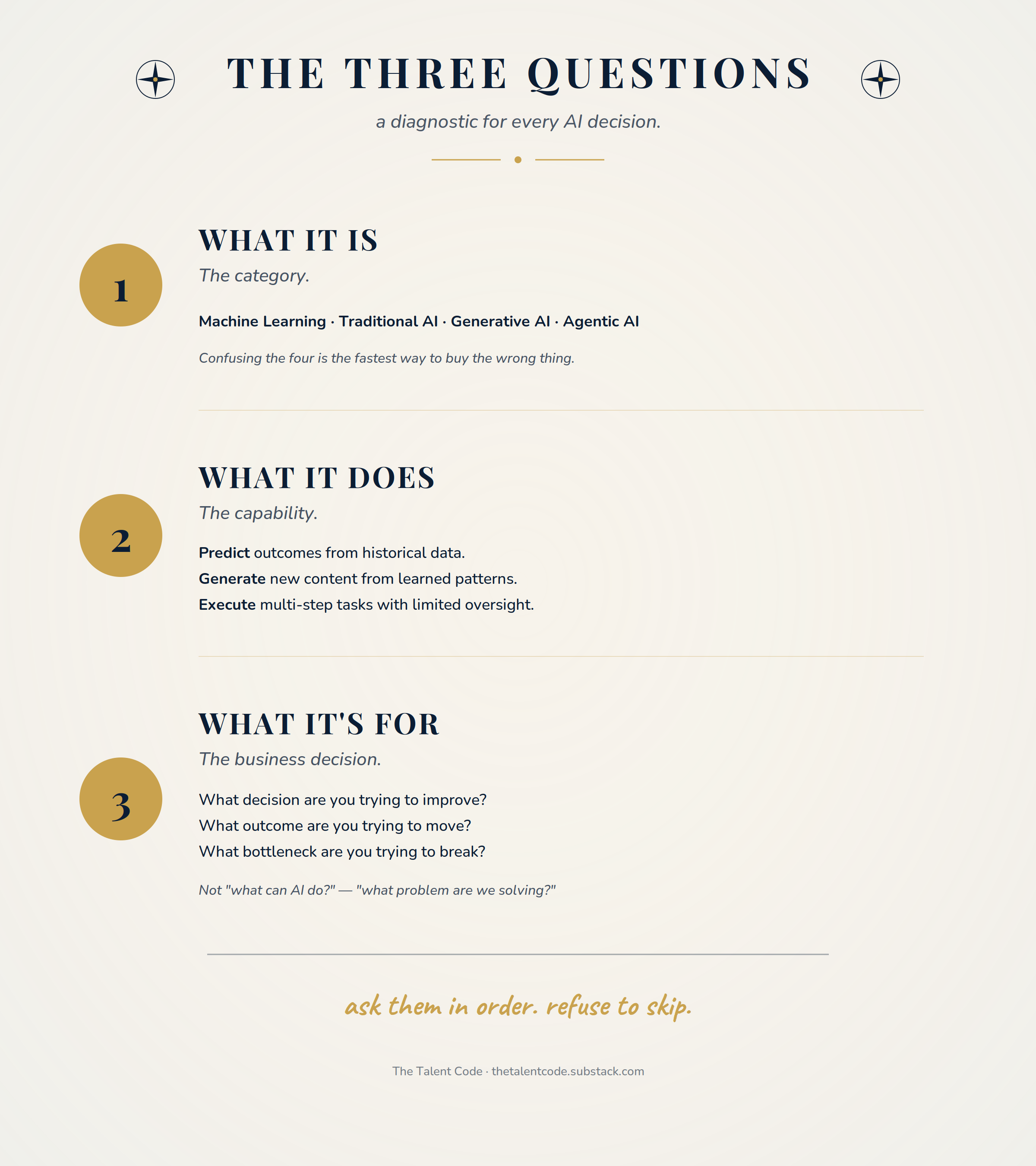
The three questions, as a diagnostic.
Let’s put it all together into something you can use.
Someone pitches you a tool. Ask what it is (which category?), what it does (what specific capability?), and what it’s for (which business decision does it actually improve?). If you can’t get good answers for these, you’re not ready to buy.
Someone proposes an initiative. Same three questions. In order. If the pitch begins with “what it does” and skips “what it’s for,” you are looking at a solution in search of a problem. Spend more time on problem definition.
Someone asks you to lead an AI project. Same three questions. If you cannot answer all three cleanly, you are not yet ready to lead the project. This is a moment to slow down and get clear before you spend other people’s money.
You are trying to figure out what to do next with AI in your own work. Ask yourself the three questions. What do I actually understand? What can it actually do that would help me? What specific decision am I trying to improve? If the answers get concrete, you have a next move. If they stay abstract, you are not ready to invest more time in AI. You are ready to invest more time in the underlying question.
I do this kind of breakdown all the time, and I will say that I’ve never had a conversation with a serious practitioner who resented the question. They typically like the reframing. I’ve had many conversations with technology partners who were annoyed by them, which usually puts them in the “solution in search of a problem” category for me. This has been a great discussion, though, for a couple of my technology partners, who have sought my team out for trial runs when they’ve created a great new technology and know what it does, but need help developing what it’s for.
So it can go in a lot of directions. Some are very positive. Some are telling—that you’re just being sold. But you can learn and course correct a ton from just having the conversation and making sure you can answer these three things clearly about the technology. Or else you might find yourself holding the bill for a shiny tool that no one knows how to use—and no one will adopt.
Now watch out for Quantum Advantage?!