Building Professional Presence Online (Without Becoming a Content Creator)
Cadence, platforms, and AI-assisted workflows you can actually use.

My mom was a college professor, so when I was a kid, my sisters and I were lucky enough to have her home. We still had plenty of chores to do between our house and my grandparents’ working ranch, but at the same time, there were times where we’d all bugger off to the pool or beach or spend a rare day inside, lost in books.
No such luck for my kiddo—summers are as busy as the rest of the year for us, if not more so. We’ve got work, he’s got camp, swimming lessons happen when it’s not pouring rain, we’re getting my grandfather’s baby grand piano fixed up and starting piano lessons, and he’s got a mom who might be wandering off to her office/mad scientist lab at any moment, working on building something or writing something or chasing down a random idea.
I like to think it just makes it more special when he and I sit down at the table on a rainy afternoon and build his Mandalorian and Grogu LEGO playset together. Because we definitely make time for that.
All that said, the one thing I don’t have time for? Professional content creation and curation. I’ve worked with some amazing folks who do this, and oh my god, do they spend time on it. Sometimes the best moments happen when they’re out and about and shoot something fun on a whim, but most of their work requires a lot of staging, editing, resourcing, researching…you get the idea.
However, if you’re just looking to better curate and present yourself online to all the human and agentic gatekeepers of opportunity who might be looking at you, the good news is that it doesn’t take a lot of time, and you don’t have to become a professional content creator. In this issue, I’ll share the workflows, the cadence, and, of course, the AI tools and platforms that I use to help me in the hopes that some of these work for you, too.
Let’s decode it. 🚀
✨ AI Tip of the Week
Use AI to draft three positioning statements for you, for how you want to be seen online when someone’s researching you.
Most of us struggle to describe ourselves as it is, and struggle even more when we have to do it in a single impactful statement. Positioning statements are good for this, both to explain to people what you do and to explain to people why they should consider you for an opportunity. AI can help you with this though!
Try this prompt:
Based on my last five to ten pieces of published work [paste or describe the pieces], write me three candidate one-line positioning statements. Format: “I help [audience] [do what] [why it matters].” Make them progressively bolder. Then tell me: which one am I currently closest to? And how do I grow into the next one over the next 12 months.
This is how you can both define and shape your positioning.
The Mechanics of Legible Identity

Last week I wrote about understanding your personal brand. Yeah, I know, I’ve avoided writing about it, but one of the things you have to know is that it’s not how you market yourself—it’s how the gatekeepers of opportunity read about you and know you. It’s how AI sees you. It’s what I call identity legibility.
Plain and simple, if the people and systems that gate opportunities can’t read who you are and what you’re working toward in a way that makes sense to them, you won’t win opportunities. And now that they’re using AI to do it, you need to have a sense of how you’re presenting yourself across all the platforms AI can see.
I offered up an audit last week to help you see that, but the question then becomes, once you’ve run the audit, once you’ve seen what needs to change, once you’ve decided on how to describe the identity that you want to become legible—how do you create the markers of that identity online?
When we talk about it, this is the point when a lot of people start to make faces and ask if they need to become professional content creators.
No. We’re not trying to turn you into someone trying to monetize your content and create partnerships. That’s hard work. You’re feeding the machine every day, and it becomes your full time job. And unless you want that to be your full time job, and you have another full time job, it’s definitely not sustainable. It’s also not what builds the kind of durable presence you need.
I’ve built a healthy presence over my platforms over the past several years, and while a lot of it has been experiments and aha moments that worked, a lot of it has been deliberate work to reach the kind of people I want to network with, work with, be booked by, and be hired by.
Let’s start with a framework.
The G•A•I•N Framework
I picked this up a couple years ago either from a marketing class or another course I took and I’m wracking my brain to figure out where—and I think I’m largely not finding it because I wrote it down wrong. Wrong for them, not wrong for me.
Here’s my version, and what I use to decide what I need to do to impact my online presence in various directions.
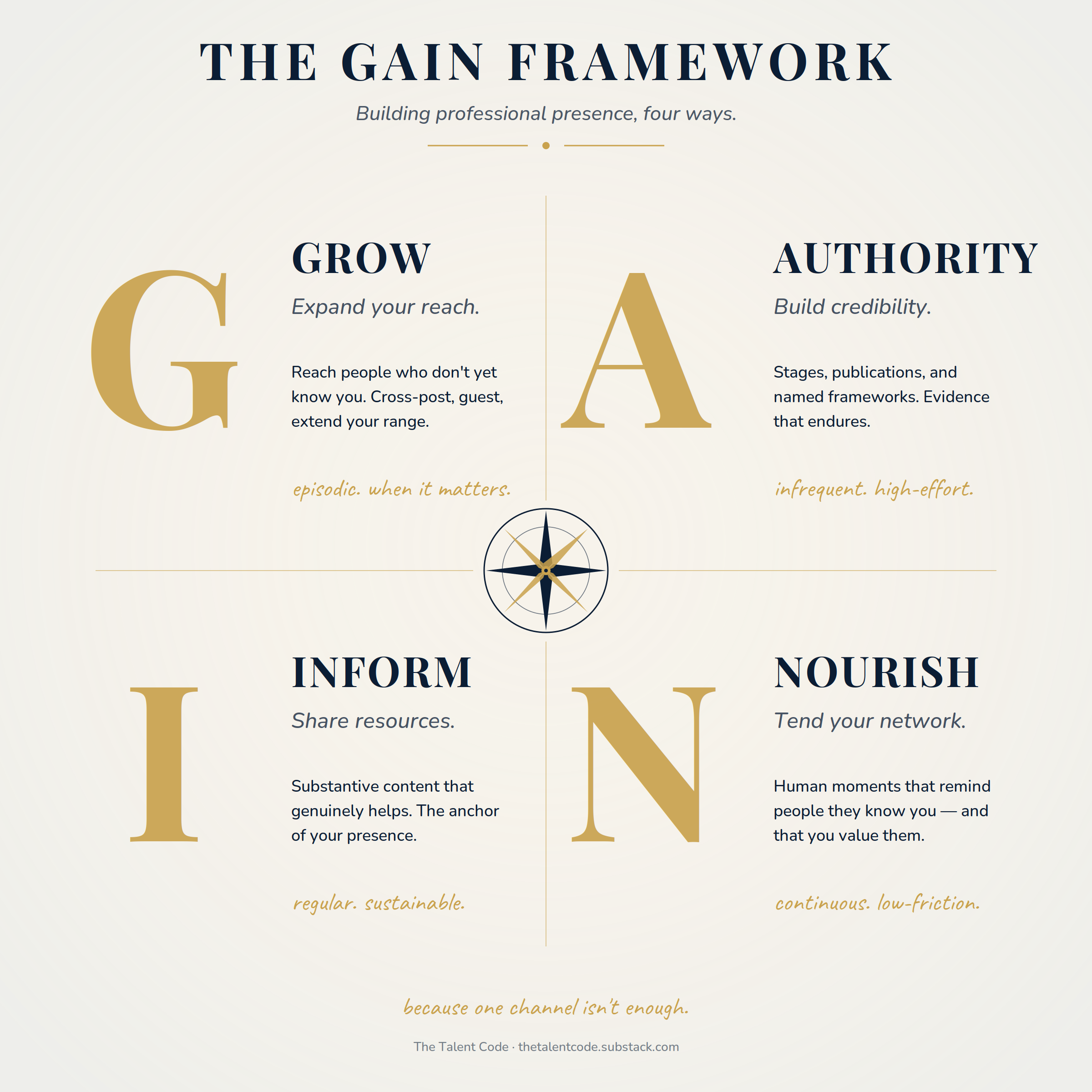
The quad chart is deliberate—this works best when you keep balance between each of the quads in terms of what you post. We’ll talk about that after I define the quads.
G — Grow. This is stuff designed to expand your presence and reach people who don’t yet know who you are. Collaborations, panel presentations, taking a speaking engagement at an organization you wouldn’t ordinarily find yourself speaking at.
A — Authority. These are the things that build your credibility. Share your professional publications, articles you’ve written, stages you’re on, conferences attended—the things that show you know what you’re doing in the space where you’ve decided to operate.
I — Inform. I consider this the domain of LinkedIn and Substack—you’re providing resources. Genuinely useful stuff that helps someone do something.
N — Nourish. Tending to your network. These are the personal, behind-the-scenes, human moments that remind people who already know you that they know you, and you value them.
You can see how too much of any of these can skew your presence.
Too much Nourish and your platforms become a daily diary. That’s great if you’re a travel blogger or a podcaster who gets to talk to amazing people regularly, but for the rest of us, it looks like photos of our lunch.
Too much Inform, and you just become the person who lectures at everyone. Maybe it’s useful, but if they don’t know you or why they should care about what you think, they’ll tune out.
Too much Grow and you lack substance. You’re flitting about doing things, but why? Why are you getting all these opportunities?
Too much Authority and maybe you’re impressive, but it’s not enough real human insight into how you’re thinking or communicating.
Building a Sustainable Cadence
You know how they tell you that the best workout is the one you actually do? Yeah, it’s the same way with creating professional presence online.
The dominant advice is to post daily, but in my opinion, that’s terrible advice. Don’t post things just to post things, post when you have something to say that you think will help people or that they want to listen to. The tricky part of social media is that it’s social—it’s a conversation and a give-and-take, not you sharing a press release or taking a turn as the town crier.
I use the G•A•I•N Framework to drive a cadence that works for me—and if you follow me here and on my other platforms, this will make sense.
Inform is my anchor. It’s regular, substantive, easy to find. Weekly on Substack, 1-2 posts on LinkedIn (one of which is usually sharing the Substack), almost never on Instagram. Your version of this might be a Substack or other blog, contributor articles, YouTube, or you might have cracked the code on how to teach the ‘gram. Still, what matters for this is that people know where to find your thinking and teaching voice and it shows up.
Grow is episodic. When you have something that you want to share with new audiences and an opportunity to do so, you do the work and expand the range of people who know you. When you don’t have anything, you don’t Grow. Trying to Grow constantly is how people end up posting empty motivational quotes and wondering why nobody is knocking on their door with an opportunity (come on, if you’ve been on social media long enough, we’ve all tried the quotes—they don’t work).
Authority is infrequent and high-effort. It’s a keynote, a published piece in a peer-reviewed or industry outlet, something you pitched at a conference, a certification you won, a hackathon prize. Authority builds slowly, but it endures. You can reach back and share old authority when it becomes relevant again (my sister and I have had fun throwing back to this article on social media influencers and influence networks we wrote for Public Relations Review—back in 2011).
Nourish is a tricky one. It can be as simple as comments on other people’s post or boosting someone’s achievement. A message to someone whose work you noticed. A shared link tagging folks who will love it. It’s not all a-day-in-the-life stuff, although sometimes those are helpful and they remind people that, you know, you’re a human and your vibe just might fit the team they’re building.
So my pattern is typically one high-effort Inform piece per week, occasional Grow moments when I have something worth expanding on, a slow drumbeat of Authority evidence, and Nourish activity in small ways every day, behind the scenes less frequently. The difference in the last isn’t posting daily, it’s engaging daily.
Platforms: Where Does My Content Live?
You do not need to be everywhere. You do not.
You cannot be everywhere without being a full time content person and we’ve already said you don’t want to do that. You’re building a professional presence to serve the work you want to do, not the other way around.
So where do you show up?
Ask yourself these things:
Where do the people you’re trying to reach spend their time and pay attention?
Where do the people you’re trying to reach discover new people?
How can I create content for them with reach and durability?
For me, Substack is where I Inform and create long-form content that I can repurpose for other platforms and often build into keynotes and training workshops. This is my library of Inform, with occasional callbacks to Authority.
LinkedIn is where I Grow and Inform with sprinkles of Authority and the daily engage kind of Nourish. This is where the decision makers who book me or hire me (or their CEOs and HR folks) live.
Instagram is mostly Nourish—behind-the-scenes glimpses of stages and conferences and podcasts or that happy hour at that rooftop bar that happens to be epic. It’s less about reaching the professional community professionally and more about, hey, if you hire me, here’s what it’s like to hang out with me.
Conferences, podcasts, industry publications, and my book are where I do Authority. High-signal, high-effort surfaces where the point is evidence, not reach—but then sharing snippets of them on my social channels and website creates more reach.
TikTok, YouTube, Twitter/X? They’re powerful platforms. But up to this point, they’re not where the audiences I court for opportunities look for those opportunities, so I haven’t prioritized them. With the latest project I’ve built, that might change—but I’ll also think about hiring a full-time communications lead.
Everyone’s map looks different, but the questions are the same—where are the people you need to make decisions about you hanging their hats? Talk to them there.
Getting an Assist from AI
I don’t have AI create content for me. I do, however, ask it to repurpose content I create for other platforms. Here are a few ways I do that:
Translation—from Long-Form to Short-Form
One long-form piece becomes a LinkedIn post, a carousel, and shorter fragments as AI does the format translation for you.
Prompt:
Here’s my newsletter piece: [paste]. Translate this into three companion formats: (1) a LinkedIn post of about 250 words that carries the argument standalone, (2) a five- or six-slide Instagram carousel with a headline slide, three insight slides, and a call-to-action slide, and (3) three short quote-graphics of the most punchable one-liners. Keep my voice: [describe your voice or paste examples]. Do not add anything I didn’t say. Do not sanitize the argument.
The carousels are sticky to me—they need to be ready to edit, not to publish, because AI…sounds like AI. But you’re still not starting from scratch.
The Stress-Test Workflow
I call this the Trollhunter. You’re never going to have people not disagree with you when you’re publishing an authority piece or an argument, but it’s nice to be able to see the other side in a way that prepares you—or to find something in the argument that doesn’t make sense that you can fix right away.
Prompt:
Here’s a piece I’m about to publish: [paste]. Steelman the strongest case against it. Where is the argument weakest? What would an intelligent adversary in this field push back on? What am I claiming that I haven’t earned? What would someone looking to pick a fight most likely pick a fight against? Be specific and unsparing.
Then decide what to strengthen, what to soften, and what to leave sharp. Some criticisms are worth taking; some are worth ignoring.
Interview Yourself
When you know you have something to say but can’t get it out or can’t get it organized, use AI as the interviewer. I hate having AI write for me but I love having AI prompt me so I can spit out a good idea.
Prompt:
You’re interviewing me for an article on [topic]. I know a lot about this, I’ve done [relevant experience] but I’m having trouble surfacing what I actually think. Ask me five to seven questions, one at a time, that will help me get to the argument I’m actually trying to make. After each answer I give, ask a follow-up if my answer was hand-wavy.
Then transcribe your own answers and edit them into the piece.
The Relationship Radar
Sometimes we need a little bit of prompting to keep connecting to the people we actually care about being connected to.
Prompt:
Here’s a list of people in my network I care about maintaining connection with: [paste 20–30 names]. Based on our recent public interactions [paste a summary or describe]: who have I not engaged with in more than [X] weeks? Which of them has posted or shared something recently that I could respond to substantively? Suggest specific engagement moves, not a generic “reach out to them,” but “comment on their post about Y” or “send them the link to Z because it connects to their work on Q.”
Also, call your mom.
Voice Consistency
Hey, mathematical models aren’t the only thing that can drift. Do you remember every word you’ve ever said? It gets worse when you’re a prolific writer.
Prompt:
Here are my last five published pieces: [paste or link]. Here’s a new one I’m about to publish: [paste]. Compare the voice, tone, and characteristic moves in the new piece against the previous five. Where does the new one drift? Am I inserting corporate language I don’t normally use? Am I missing my usual voice moves? Am I over- or under-doing anything in ways that would jar a regular reader?
I’m kind of protective of my voice. I also tend to pick up things quickly, which include talking points, and I try hard to make sure that those don’t just work their way into my writing without me noticing and citing them.
A Couple Other Tips
Here are a couple other things that have helped me be responsive without having to be on social media all the time, and be a prolific writer without also having to be on the computer all the time.
Schedule posts. Seriously, it’s the best. Put together 2-3 pieces of writing when you feel like writing and schedule them. Using a free service like Buffer helps.
Block time for engagement. It doesn’t take much—take a 15 minute break during the day to reach out to folks or reply to comments and keep the digital house clean.
Ease the pressure. It’s easy to feel like you have to do things a certain way and post at a certain frequency, but you don’t. Do it when the content makes sense and when it feeds the positioning statement you created—the reason we’re doing this, remember? Online efforts feeds our work, it doesn’t become our work.
You’re not a celebrity. Paparazzi aren’t hanging out waiting to see what you wore or what you ate for lunch. Don’t be your own paparazzi.
Remember who the audience is. Hint: it’s not you. This is what keeps your personal brand from being a vanity thing. Online communication is for you to communicate with the audience you want to reach and you want to give you access to opportunities.
I design moments throughout my week to engage and create but I mostly just do it when I feel like it. I find, though, that creating ahead of time and waiting to a more strategic time to share it helps me remember to edit, take the pressure off, and decide if it’s something that really fits the identity I’m working on communicating at all.
So Why Are We Doing This Again?
This is that audience reminder. The purpose of working on your professional presence online isn’t to figure out how to become a content creator—it’s to open the door for the work you want to do where your audience lives and where AI can find you.
Build a system that you can handle. It’s not your full time gig. It’s not even a side hustle. It’s something that helps that AI summary fill in interesting things about you, your expertise, and your interests when someone creates a background sheet or bio on you in preparation for a meeting or a job search or filling that keynote role.
Presence serves your work, not the other way around. And hopefully this helps you create the presence you want to be known for—and hired for.