Assessing Your Organization's AI Maturity
The nuts and bolts of becoming an AI-enabled organization.


And, bam, there goes my first week of “retired” life!
Nine days ago, I returned the Class A’s to my closet for what was likely the last time (except for the occasional ceremony) and then we all frantically packed to spend the better part of a week out at sea on the Disney Fantasy. Now I’m back in the mix and finalizing paperwork while I figure out what my new normal is going to look like.
But things don’t stop around here. People keep telling me to take months or even years off, but that’s not how I operate. I mean, I can’t even be at the house for more than a few days without tearing out a wall or two and having Amazon packages and Lowe’s deliveries fill the entire front porch. In the meantime, I’m gearing up for my next role but also preparing for a couple of upcoming workshops and speaking events and my upcoming DBA program this fall at the University of Miami!
I’ll spare you the full transition reflection. That’s for another article a few months from now, depending on how successfully I do this. Instead, let’s dig into the stuff I’m actually good at—not relaxing nor being retired, but talking about all things AI in your workforce and in your organization. But let’s start with something new.
✨ AI Tip of the Week
Using AI as your Napoleon’s Corporal.
Most people use GenAI to produce output. Write the email, summarize the report, generate the slide. That’s fine. But AI can be your best Napoleon’s Corporal. You know, that guy who sits there and asks questions when he doesn’t get it and throws you some insights on where you’re making assumptions or skipping key explanations?
Pick something you produced this week, like a meeting agenda, a draft strategy doc, the slide you pitched to leadership, and ask AI to read it as a stranger would. Not “improve this.” Not “rewrite this.” Just: what do you actually see? And what did you actually glean from my explanation?
Try this prompt:
Read this document as if you’ve never seen it before and don’t know me. What is the author actually saying? What are they implying without saying? What are they avoiding? What’s strong, and what’s hand-wavy? Be specific.
What surprising insights did you get?
Now let’s decode something fun—not your individual but your organization’s AI literacy! 🚀
From Individual to Team
What does your organization need to be capable of for you to say you’re using AI effectively?

I was on a call recently with leaders from a large organization who had just hit the six-month mark on their AI rollout. They’d done it well, by most measures. They’d selected enterprise tools. They’d negotiated the contracts. They’d run the trainings. Adoption metrics were healthy. Most of their workforce had access. Many of them were using it daily.
And they could not, for the life of them, answer this question:
Is this actually working?
They had token usage data and prompt counts (please don’t use these as targets, please — this is how you make your AI program expensive). They had a few testimonials. What they didn’t have was an answer to whether anything in their business had measurably changed because of the investment.
This is a familiar refrain for some of us.
This tech adoption challenge…we’ve been here before.
If you’ve been in data work for any length of time, you’ve seen this movie.
We chased big data. We chased cloud. We chased agile. Each time, the same arc: a powerful new capability arrives, leaders feel pressure to adopt it, organizations build the infrastructure and run the trainings, and somewhere around month nine to fourteen, somebody asks the question.
Is this actually working?
And the org realizes it has invested heavily in a capability without ever defining what outcome the capability was supposed to deliver.
Big data didn’t fail because the technology was bad. It failed where it failed because organizations bought data lakes before they figured out what decisions they needed to make differently. Cloud didn’t fail because the providers couldn’t deliver. It failed where it failed because organizations migrated workloads without ever asking who actually needed to access the data and workflows and whether cloud was the best solution for them. Agile didn’t fail because the methodology was bad. It failed where it failed because organizations adopted ceremonies without ever changing how decisions actually got made.
The pattern is so consistent it should embarrass us. Each technology cycle, we deploy fast, we measure activity, we assume outcomes will follow, and we end up with a sophisticated capability nobody can defend to the board.
AI is that pattern in faster motion.
Okay, so…what’s different?
The thing that’s actually different about AI is that the technology is genuinely transformative at the individual level.
I introduced a couple of frameworks—the AI Maturity Ladder, for one—to track just how well people were doing at upskilling individually in AI (predominantly GenAI and Agentic AI using broadly available commercial tools). The Ladder—Search, Converse, Apply, Build, Orchestrate—especially when combined with the Department of Labor AI literacy categories, describes a real progression that people are actually moving through. I’ve watched mid-career professionals jump from Search to Build in a just a couple sessions. Individual AI literacy is happening, faster than I expected, and broader than most organizations realize.
Read more about the frameworks here:
But let’s talk about the organizational change management component.
You can have a workforce full of people sitting at Apply and Build, capable of automating their own work and prototyping new tools, and still have an organization that can’t translate that individual capability into better decisions or better outcomes.
That’s the gap this article is about.
Individual competence is the floor. Organizational capability is the ceiling.
I’ve been using that line for a while, but let’s talk about how you can actually measure it and what you can do about it.
The AI Org Maturity Matrix
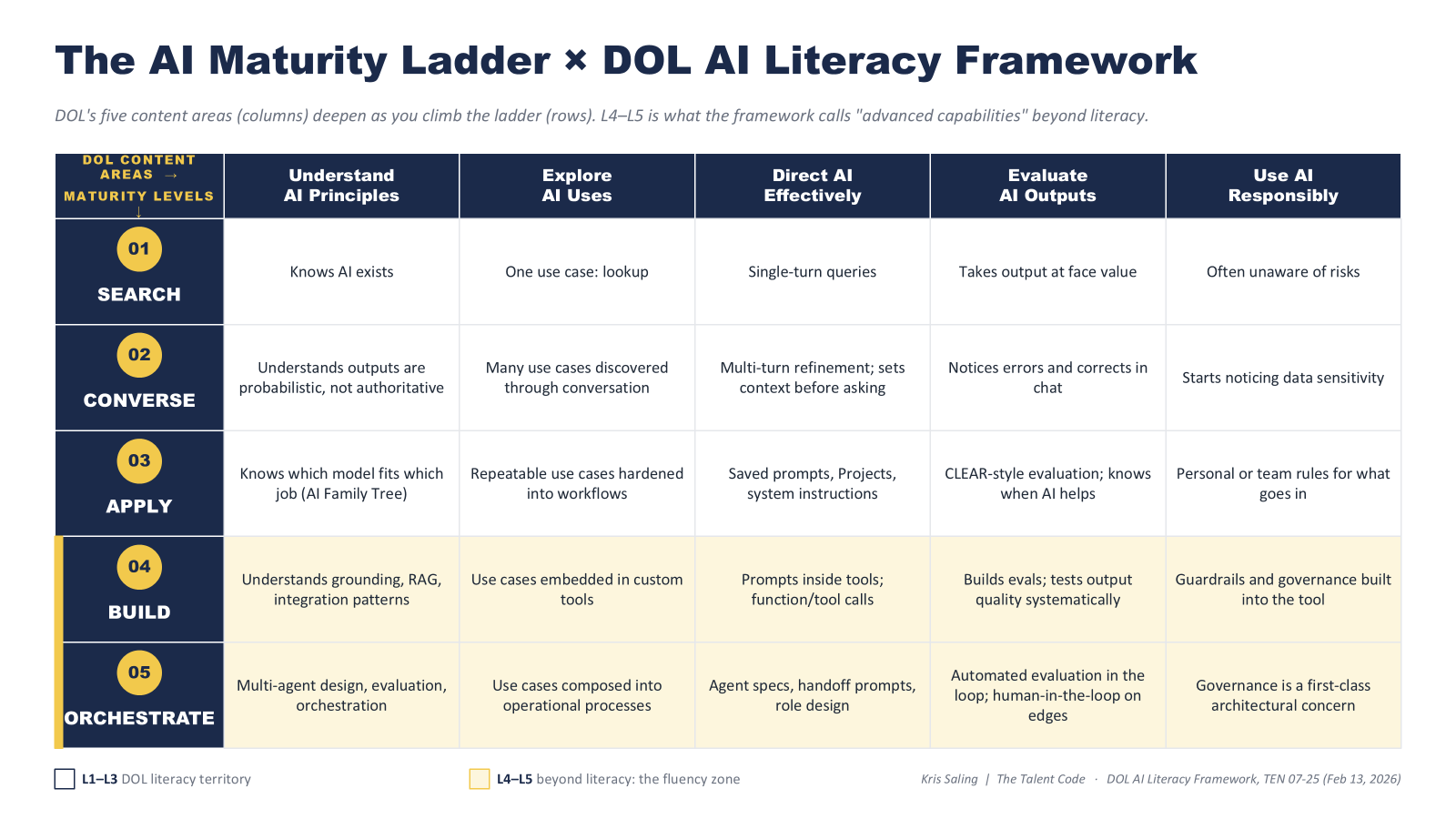
The individual AI Maturity Ladder is two solid dimensions once you combine it with the DOL AI Literacy Framework, but still, you’re looking at the maturity of an individual’s skills. You’re not really looking at whether they—or your organization—are accomplishing anything.
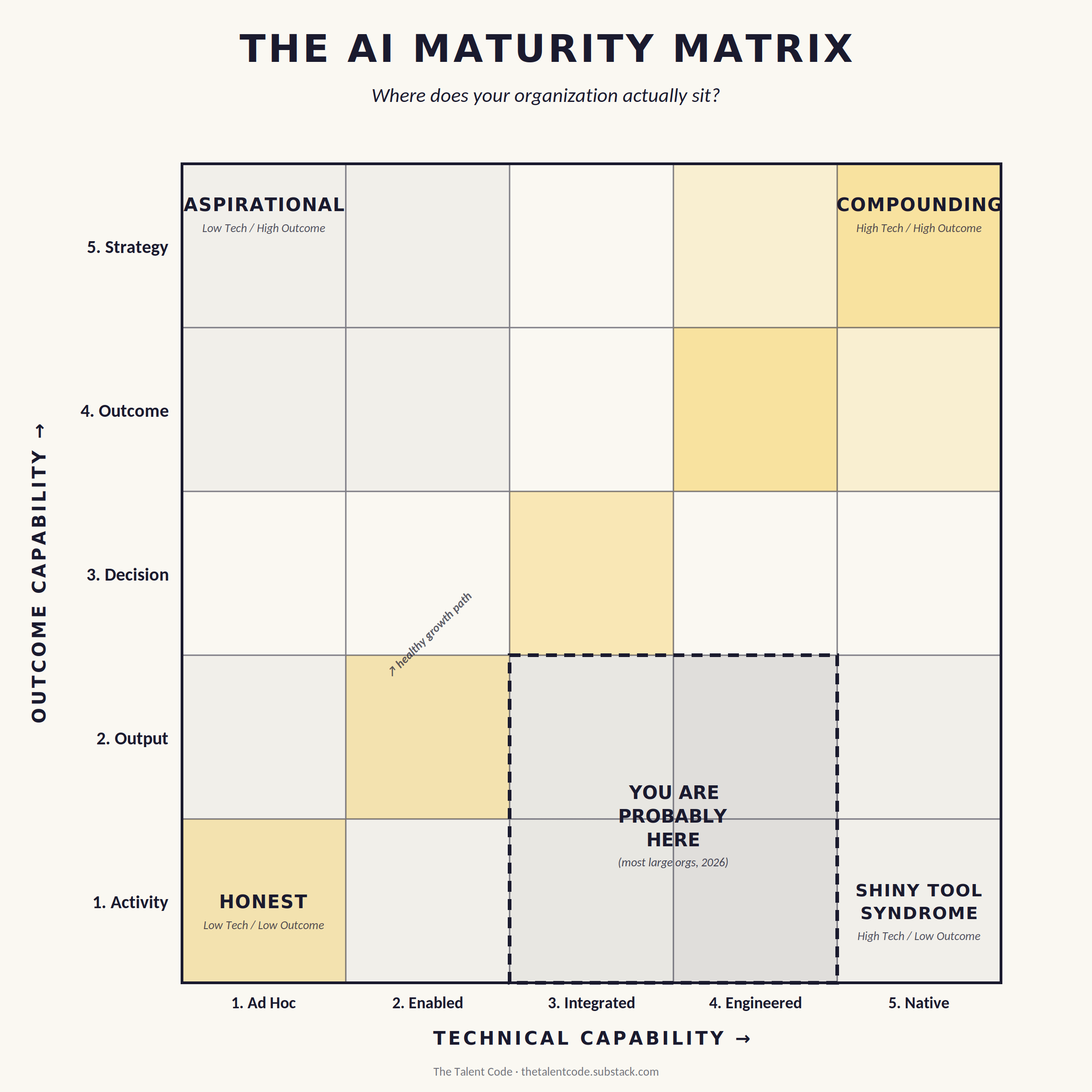
Organizational capability is a relationship between two distinct factors that have to advance together.
Technical Capability is what your organization can actually do with AI: the infrastructure, the data, the integration, the engineering work that determines what’s possible at scale.
Outcome Capability is what your organization actually gets from AI: and more importantly, how it measures whether AI is contributing to the decisions and outcomes that matter.
Most maturity assessments measure the first one, and like mine, just do it for individuals. Almost none of them measure the second. And the mismatch between the two is where most organizations are quietly failing right now.
So let’s take a look at these factors…and where you might be.
Technical Capability: What You Can Do
Level 1: Ad Hoc. Individuals are using personal AI tools. Some are good at it, some aren’t. The org has no awareness of who’s doing what. No coordination, no shared infrastructure.
Level 2: Enabled. The organization has provided tools and access. People can use AI through approved channels. Usage is uneven and often un-coordinated, but the door is open.
Level 3: Integrated. AI is woven into key workflows. Shared infrastructure exists. Teams have agreed practices for the work they own. It’s no longer just available — it’s part of how work gets done.
Level 4: Engineered. AI is enterprise infrastructure. Data architecture, security, identity, and integration are all designed for AI, not retrofitted to accommodate it. Capabilities can be built and deployed at scale.
Level 5: Native. AI is embedded in how work itself is designed. The organization isn’t just using AI, it’s building and orchestrating AI capabilities tailored to its mission.
Outcome Capability: What You Get
Level 1: Activity. You measure AI by usage. Percent of employees with access. Number of prompts. Number of trainings completed. You can prove the rollout happened. You cannot prove anything beyond that.
Level 2: Output. You measure AI by what it produces. Drafts written, hours saved, tickets closed. You can show productivity. You cannot show that the productivity changed anything important.
Level 3: Decision. You measure whether decisions made with AI are better than decisions made without it. Sharper, faster, more defensible, better calibrated. You’re evaluating AI on the work that actually shapes the business.
Level 4: Outcome. You measure whether business outcomes, the ones the board actually tracks, are moving as a result of AI investment. Customer outcomes, mission outcomes, financial outcomes. You can defend the program to the CFO.
Level 5: Strategy. AI enables bets you could not otherwise place. The organization is doing things that were not possible before AI, and those things are reshaping its strategy, not just its operations.
The threshold from Output to Decision is the killer one. That’s the hill most organizations are sitting at the base of right now, very proud of how many people have access and how many prompts are running, with no honest answer to and so what?
Where the mismatch lives
The interesting thing is not where your organization lands on either component. It’s where the two are mismatched. The mismatches are how you diagnose what’s actually going on.
High Tech / Low Outcome → Shiny Tool Syndrome
This is the most common mode in 2026. Big investments. Sophisticated infrastructure. Lots of activity. No defensible business case.
The signal: when someone asks “is this working?” the answer involves a lot of usage statistics and very few changed decisions or outcomes. The CFO is getting nervous. The CEO is getting impatient. The team that built the capability is on the defensive.
The fix is not more tech. It’s investing in the decisions you’re trying to improve and the outcomes you’re trying to move.
Low Tech / High Outcome → Aspirational
Leadership is talking about decisions and outcomes. The strategy deck is right. The vision is articulated. But the infrastructure can’t deliver. Data is fragmented. Integration is broken. The engineering muscle isn’t there.
The signal: every conversation about AI is a conversation about a future state. Nothing is shipping that actually changes how work gets done.
The fix is to build the infrastructure that lets the strategy become real. Slowly. Without losing the strategic clarity in the process.
High on Both → Compounding
This is rare. When organizations get here, capability and outcome reinforce each other. New technical capability immediately unlocks new outcomes. New outcome goals immediately drive technical investment. The flywheel turns.
The signal: AI investment decisions are routine and well-understood at the leadership level, and the people doing the work can articulate what they’re trying to change and why.
The job here is to protect what you have. Compounding flywheels are fragile, and they’re usually one reorg or one departure away from breaking.
Low on Both → Honest
This sounds bad. It’s not, necessarily. Low on both means the organization hasn’t yet pretended to be further along than it is, and you have a clean slate to get started. And you have an honest assessment of where you are. I named this one “Honest” deliberately, just because this is where a lot of orgs are and admitting it is the first step of making a plan to grow and learn.
At least here, nobody’s claiming the AI program is working. There isn’t one yet. Or it’s small and clearly experimental.
The fix is to pick one of the two dimensions to invest in deliberately, and to refuse to fake progress on the other. Most organizations that end up in Shiny Tool Syndrome got there by pretending they were further along than they were and over-investing in tech without the outcome muscle to match.
Okay, so…where are we?
Most large organizations in 2026 who say they have adopted AI and have people actively using AI are sitting at Technical 3 or 4 and Outcome 1 or 2.
They’ve made significant investment in tools and infrastructure. They’ve trained a meaningful percentage of their workforce. They have governance and policy. They can produce a slide deck about their AI program that looks impressive.
They cannot tell you what decisions are being made better. They cannot tell you what business outcomes have moved. They cannot tell you, with any rigor, whether the program is worth what it costs.
This isn’t embarrassing—it’s just where most orgs are because the conversation about AI is still mostly dominated by tools, vendors, and adoption metrics that are easy to count that don’t have anything to do with whether or not you’re getting anything done, and might actually be harmful for your organization.
The fix is not another platform, or even an individual AI literacy program. Let’s talk about what you should actually do here.
How to move

The work is different in each quadrant, but the principle is the same: advance both components together.
If you’re in Shiny Tool Syndrome, stop adding tools. Pick three decisions your leadership team makes regularly that are high-stakes and currently made on incomplete information. Build measurement and AI assistance around those decisions specifically. Track whether the decisions get better. Resist the urge to roll out more tools until you can answer “what got better?” for the tools you already have.
If you’re Aspirational, invest in the infrastructure that makes your strategic vision possible. Not all of it. The thinnest version that lets you ship something that changes a decision or moves an outcome. Don’t build for hypothetical use. Build for the specific outcomes you’re already talking about.
If you’re Compounding, protect the conditions that got you here. Map who owns the relationships between technical and outcome work. Document how decisions get made. Ensure that institutional knowledge is captured and the flywheel survives turnover and the next reorg.
If you’re Honest, be deliberate. Pick one component to invest in first, based on where your organization’s actual problem is. If your decisions are weak, invest in Outcome Capability first. Define the decisions you want to improve before you buy the tools to improve them. If your infrastructure can’t deliver anything, invest in Technical Capability first, but with a specific decision or outcome already in mind.
In all four cases, the people who need to be in the room together are the ones building the technical capability and the ones accountable for the outcomes. That sounds obvious. It is not what most organizations are actually doing.
What this looks like in YOUR organization
Most readers of this newsletter already know where their organization sits on this maturity matrix. Some of you have been trying to articulate the gap and didn’t have language for it, and I’m hopeful these frameworks are helpful.
The Ladder helps individuals see where they are. The Matrix helps you see whether your organization can act on what you know.
If you’re a person sitting at Apply or Build inside an organization sitting at Tech 3 / Outcome 1, you already know what that feels like. You’re doing work your organization can’t translate into anything that matters at the level of the business. That’s an unsustainable position.
The work of teaching AI is not done when individuals can use AI. It’s done when organizations can do something with what their individuals can use.
So how are you all using AI, and how will you grow your organizational capability?