
A Winning Team Takes a Team
What Army Talent Management can learn from Team Sports

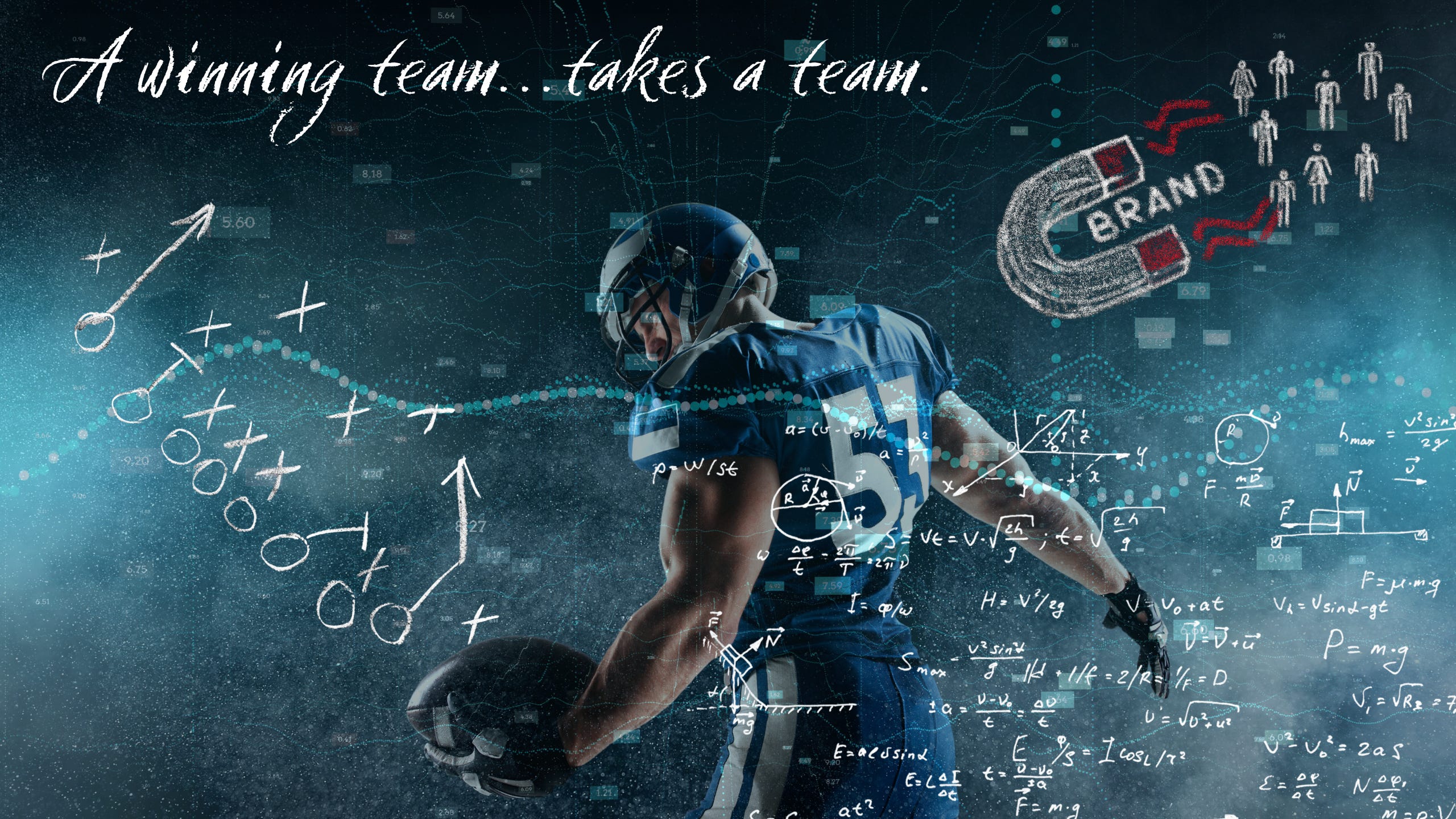
Last week, I came home from the IGNITE 2025 event feeling supercharged. There’s nothing quite like being in a room full of people who believe—deeply—that talent is the engine of transformation. Whether we’re talking about digital modernization, organizational redesign, or building systems that can actually adapt to change, talent is at the core. Always.
And this week, when I came home from another week of grinding at the Pentagon on the reductions we’re slated to make, and how to preserve key functions, I reflected on those discussions all over again. And we continually think too small when it comes to our focus on talent.
We talk about hiring. We talk about skills. Maybe we even talk about workforce planning.
But we rarely talk about the full ecosystem of talent—all the roles and disciplines that make high performance possible. It’s not just the person on the field or the person in the fight. It’s the team behind them. The people who scout, train, coach, analyze, nourish, heal, and align. The strategists, the scientists, the storytellers.
So this week, I’m taking a play out of the football team playbook to make the case that building the most lethal Army—or the most competitive organization—requires a full-spectrum approach to human performance, coaching, analytics, and support.
Let’s decode it. 🚀


Before we dive in, a little context: I come from a sports family. My dad was drafted by the Rams in 1974 and went to the Olympic trials in track and field for the shot put. My sister went to the Olympic trials, too. I’m the family underachiever: I had a solid high school and college career in track and field and I went to the Olympic trials—to cheer my sister on 😁. But I’ve always been a huge fan of sports, especially football.
I think it’s because the ecosystem behind the game has always appealed to me. It’s never just about the twelve people on the field. It’s about the dozens—sometimes hundreds—of people behind them who build, coach, equip, heal, support, and believe in them. Everyone is invested in them winning. That’s what makes it powerful. That’s what makes it work.
And I think that’s the mindset we need when we talk about talent. I used football as a framework for how we think about talent many times in my book, Data-Driven Talent Management, because so many times, we default to a “one size fits all” perception of what talent is. It’s not just the quarterback—the QB needs wide receivers and an offensive line. The team needs the special teams (how many times has the kicker clinched a tight game?). But there’s a lot more off the field that the team needs.
So what does it actually take to have a winning team, and why is football such a team—of teams—sport?
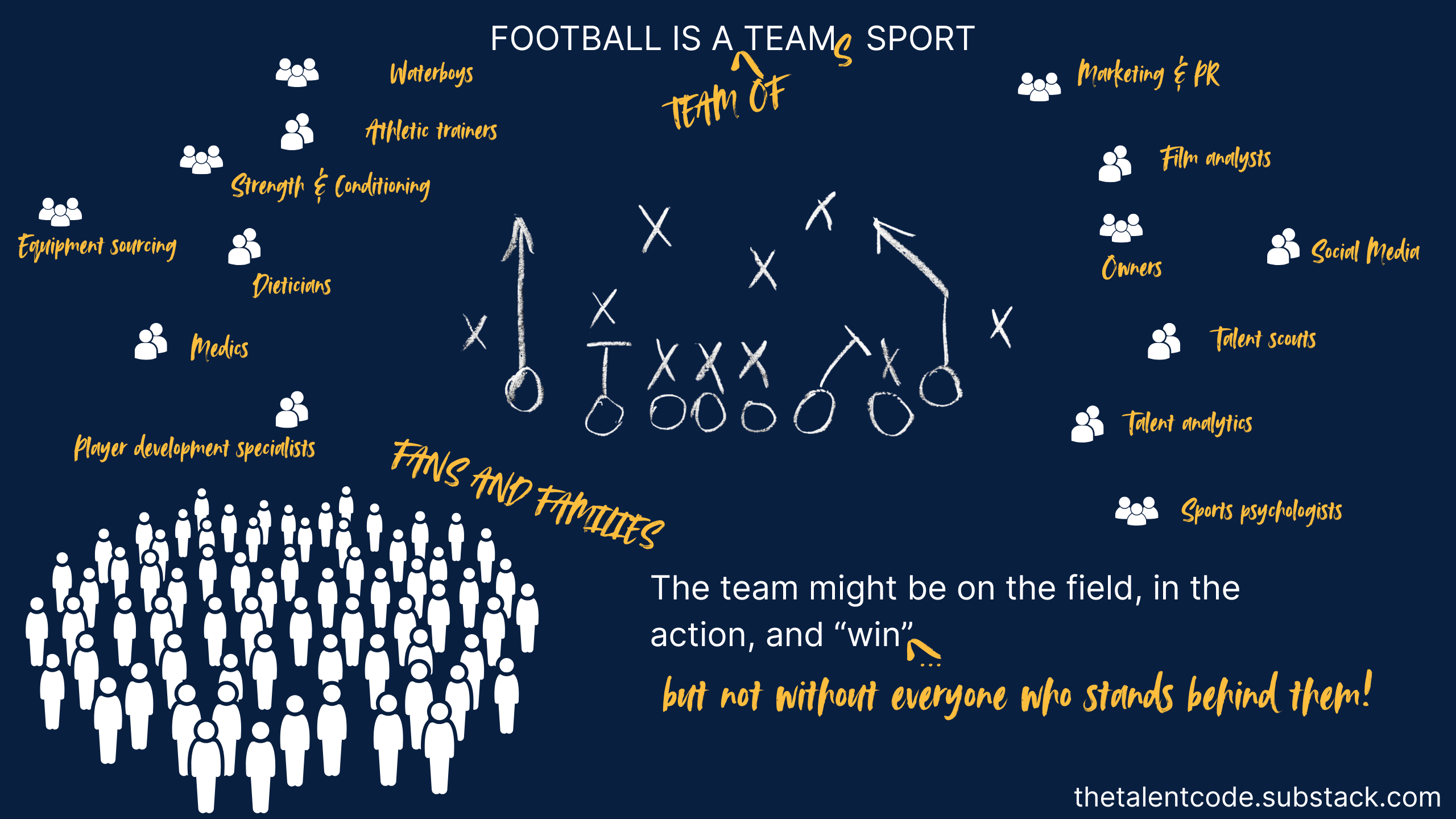
You Don’t Build a Winning Team with Just Players and Plays
What the NFL Can Teach Us About Building the Talent Ecosystem We Actually Need
There is a full engine of talent that powers the talent on a professional football team. Granted, you need those great players and great plays to win the game, but part of having those great players and great plays is building a complete, aligned, and high-functioning ecosystem that supports every element of performance.
Teams that win invest in much more than just the starting lineup. They invest in:
Strength and conditioning coaches
Nutritionists
Psychologists
Analysts
Talent scouts
Coordinators and mentors
Data infrastructure
Culture builders
They treat every aspect of performance—mental, physical, emotional, strategic—as worthy of resourcing, optimizing, and integrating.
That should be the model for anyone who is serious about talent.
The Illusion of the Lone Performer
One of the biggest myths in both sports and the workplace is the idea of the “heroic individual”—the superstar who carries the team, the high-performer who doesn’t need support, the Soldier or employee who just “figures it out.”
But no quarterback wins a Super Bowl alone. No squad leader accomplishes their mission without a team. And no organization builds sustainable excellence without a structure behind the scenes that supports people before, during, and after the game.
The modern workforce is complex, cognitive, adaptive, and emotionally demanding. And yet we often under-resource or ignore the systems that enable people to do hard things well:
Coaching
Feedback loops
Recovery time
Mental fitness
Skill development
Talent alignment
Individualized growth paths
Let’s break down a few components of what makes NFL teams high-performing ecosystems and think about what that looks like when applied to the Army, government, or corporate workforce.
Performance Coaching Isn’t Optional—It’s Expected
NFL players don’t just show up and grind. They work closely with position coaches, strength coaches, mental performance coaches, and nutritionists. Why? Because the margin between average and elite is narrow—and small optimizations compound into massive gains.
In the Army, we’ve started to institutionalize this thinking through H2F (Holistic Health and Fitness)—but we have to go further. We need to make coaching, feedback, and individualized development part of how we lead, not just how we rehabilitate.
Just like a pro team wouldn’t send a rookie onto the field without film review, a playbook, and a development plan, we shouldn’t send a new lieutenant or squad leader out without that same level of preparation and support.
Data Drives Insight
Every player watches film. Every coach analyzes performance data. And every decision—from matchups to formations to plays—is informed by data, context, and coaching insight.
But in a lot of organizations, especially large ones like the Army, we still rely heavily on gut instinct and past experience. That’s useful in some cases but it’s incomplete—and I’ll probably take that topic on in next week’s Talent Code.
We should be operationalizing people analytics to understand:
Where our talent is strongest
Where it’s misaligned
Who needs development, and in what areas
What team combinations drive performance
How to identify high-potential individuals early
If the NFL uses data to design plays and structure rosters, why wouldn’t we use it to design mission-aligned teams?
Recovery and Resilience Are Built, Not Assumed
Football is physically punishing. That’s why NFL teams invest heavily in rest, recovery, and resilience, sleep science, cold therapy, massage, nutrition, and psychological support built into the schedule.
Meanwhile, in the Army? All of us have heard things like “sleep is a crutch” and people seem to think our bodies should be so efficient that we can always go farther on less food and fewer rest breaks, and we treat burnout as a personal failing instead of a systemic issue.
Soldiers, civil servants, and employees are often expected to perform at peak levels with inadequate rest, unclear expectations, and minimal support systems. That’s not resilience. It’s erosion. Just because your system hasn’t broken yet doesn’t mean your “check engine” light isn’t on, and many of us perform perpetually with the check engine light on, or in Army maintenance parlance, a circle-X deadline fault (one that would normally sideline a vehicle but that a commander has elected to assume risk on due to mission requirements).
True readiness means understanding that recovery is part of performance. If we want a resilient force or workforce, we have to design one.
Talent Isn’t One-Dimensional—It’s Systemic
In the NFL, it’s not just about raw athleticism. Teams consider:
Cognitive processing speed
Communication style
Leadership under pressure
Alignment with team dynamics and coaching philosophy
Similarly, in the Army or any modern organization, performance isn’t just about task execution. It’s about:
Emotional intelligence
Adaptability in ambiguity
Mission command readiness
Strategic and creative thinking
Yet we still too often reduce talent to rank, time in service, or a single rating—often ones that have nothing to do with what we’re actually trying to measure. We need to invest in multi-dimensional talent strategies that look at potential, fit, readiness, and team dynamics—not just credentials.
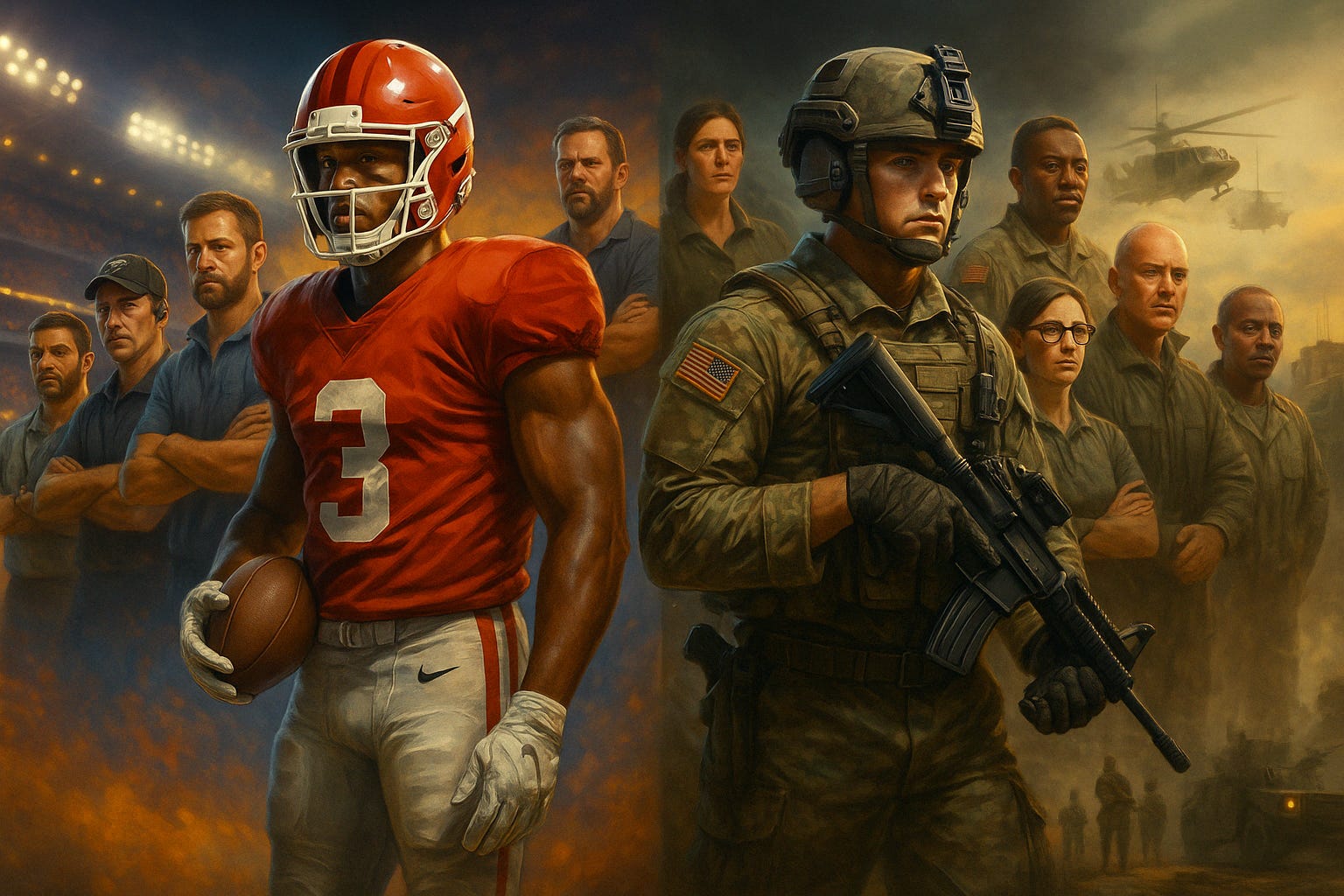
The Army as a High-Performance Team
If we truly believe that warfighting is a human endeavor, we have to ask ourselves: Are we building the human systems we need to win?
We’ve started with H2F. But to reach the next level, we need to treat talent and performance like operational imperatives, not administrative afterthoughts.
That means investing in:
Science-based training and recovery
Mental and cognitive performance, not just physical
Data-driven talent alignment
Coaching and mentorship at every level
Leadership development based in behavioral science
Systems that reward growth and learning, not just endurance
You Win With the Whole Team—and Not Just the Team on the Field
Whether you're building an NFL roster, an Army formation, or a public service organization, the same truth applies:
You don’t win with just players and plays. You win with the system behind them.
Building talent isn’t about finding superstars and pushing them harder. It’s about building an ecosystem that allows everyone to play at their best—and become better over time.
That’s how you build a winning team. That’s how you build a ready force. And that’s how we build the workforce we need for tomorrow’s fight—whatever field it’s on.
Let’s stop asking people to figure it out alone. Let’s start building around them. 🚀
Talent Trends & Insights
Here are 5 things I’m paying attention to this week.
1. IRS CIO Resigns Amid Leadership Exodus and Data-Sharing Concerns
Rajiv Uppal, Chief Information Officer of the IRS, announced his resignation effective April 28, 2025, joining a wave of high-level departures from the agency, coinciding with significant changes made there under DOGE. This, especially during tax season, is enough to make you worry about the stability and direction of federal data management that has the potential to impact, well, literally everybody.
2. Pentagon's Defense Digital Service Team Resigns En Masse
Nearly the entire staff of the Defense Digital Service (DDS), known as the Pentagon’s "SWAT team of nerds," is resigning by the end of April 2025, after stating that they felt marginalized under DOGE’s restructuring efforts. They’re not the first digital modernization team in the federal government to bite the dust, though—the U.S. Digital Service was subsumed by DOGE, 18F at the GSA was eliminated by DOGE, and political infighting, hiring freezes, travel restrictions, and an increasing number of bureaucratic layers have all but choked out innovation in the DoD as well.
3. Former UK Prime Minister Advocates for Digital IDs and Facial Recognition
Tony Blair has called for the implementation of digital identities and live facial recognition technology to modernize the UK's criminal justice system. He argues that these tools can enhance efficiency, reduce fraud, and improve public safety, despite ongoing debates over privacy concerns and inherent biases in these technologies. We’re seeing more and more of a push for digital IDs and facial recognition over standard forms of identification worldwide (every time I’m in the airport, I run into a new digital pilot), so I don’t think there’s much of an “opt out” option—instead, think about what you can do to safeguard your identity and your digital footprint.
4. Quantum Computing Enters a New Era with Major Tech Investments
The quantum computing industry has reached a pivotal milestone in 2025, with significant advancements from major tech companies like IBM, Amazon, Microsoft, Google, and Nvidia. These developments promise transformative impacts across sectors, including medicine, cybersecurity, and data processing. This rapid progress in quantum computing underscores the need for specialized talent and robust cybersecurity measures, as quantum's potential to disrupt existing systems becomes increasingly tangible.
5. National Academy Task Force Releases Report on AI in Disability Benefits
The National Academy of Social Insurance's Task Force on Artificial Intelligence, Emerging Technology & Disability Benefits has published its Phase One report, examining the Social Security Administration's (SSA) current and potential use of AI in the disability determination process. The report outlines both the opportunities and risks associated with integrating AI into critical public services. As more government agencies explore AI applications, this report underscores the importance of balancing technological innovation with ethical considerations, particularly in programs that directly impact vulnerable populations.
Final Thought: Talent Takes Teams
In a world that loves to celebrate the lone performer, we can’t afford to ignore the truth—greatness is rarely a solo act. Whether you’re on the battlefield, in the boardroom, or on the football field, success is built through teams—and teams of teams—each supported by systems that enable human potential to thrive and become action. If we want to build high-performing organizations, we can’t just design for the individual—we have to invest in the ecosystem around them.
Always enjoyable following your articles. Well thought out and superbly written.
I was surprised at the shout out… but thank you, it was fun reliving it.
Excellent article! Love this! Thank you for the work you’re doing (and your team)!